Field of Science

Showing posts with label gardening. Show all posts

Debunking Moss Graffiti

Have you heard of moss graffiti or moss art? Outdoor walls and surfaces covered in mosses shaped into words or images (Google Images). Many articles on the internet promote mosses as an easy way to create living/green art. As a scientist who regularly grows mosses in the laboratory I have a number of issues with this art form, but let's start with methods. 


 There are two methods described online for making this type of live wall art. 

#1 The milkshake technique - Collect a few clumps of mosses. Grind up the mosses in a blender with buttermilk, beer, or some other liquid to help the moss stick to the wall. Then paint the mossy solution onto the wall. Water the mossy area to help the mosses to grow. 

#2  Collect patches of mosses. Trim and arrange them into the desired design. Then paste/attach them onto the wall.

The problem with many of the descriptions online is that method #1 is outlined and then art made using method #2 is displayed as the result! There are many before photos and videos for the milkshake technique (herehere, and here), but hardly any after photos. This is the best one I could findWhy do very few people show the results of the milkshake technique (method #1)? Well, mosses are not fast growing plants. After painting mosses onto a wall they need to be kept constantly moist and will take a long time to grow. I think that many people try out this technique and few plants grow. 

Why does this technique seem to fail so often? In theory this technique could work. All moss cells are totipotent, meaning each individual moss cell can regrow an entire moss plant. However, moss species are often very specific to where they grow. Some species grow only on soil, others on trees, and still others on rocks. The success rate will probably be low if mosses that usually grow on soil or wood are painted onto concrete or brick walls. Another reason they may not grow is that the surface is not moist enough.

The vast majority of the moss graffiti images online were not made using the milkshake technique. The lush mats of mosses in the shape of a creature or phrase with crisp edges were instead made from fully grown mosses. Very few sites describe the process wherein they harvest mosses, cut them into those amazing shapes, and then use a paste to attach them to the wall. Most mosses used for horticultural or ornamental purposes are collected from the wild. The mosses used in these pieces may be able to stay alive or continue to grow for a while, but I wonder how long they can stay alive without constant watering and maintenance. My guess would be that they can stay alive for a bit, but in the end they would eventually die. 

These urban displays of mosses are beautiful, but I think that it is important to consider the cost of this beauty. Where was the beautiful moss taken from to put onto this wall?

I think it is a fun activity to move mosses around the yard on a local scale to landscape with mosses. I am also in favor of purchasing mosses from a grower that produces them sustainably or rescues them from development sites, like Moss'in Annie. However, I imagine that many of the mosses used for these art/graffiti installations were not sourced in an eco-friendly way, but were instead pillaged from the wild. The strip mining collection of mosses is a big business with much of the collection in the United States happening in the Pacific Northwest and in the Appalachian Mountains. Personally and professionally I am opposed to this type of collecting. Many of these mosses are long lived plants that are growing in old climax communities. They could easily be 10 to 50 years old and it could take at least that long for them to regrow. Wild collection on a massive scale is just not sustainable industry. 

Consider a hunt for urban mosses that are hiding in plain sight. Any moist place is a great location for mosses to grow. In the cracks or at the edges of the sidewalk. Beneath a dripping window air conditioner. Around the base of a tree trunk. Mosses are writing their own graffiti and they are adding a bit of green to the man-made world that surrounds us.  

An alternative to adding mosses to walls is to remove some of the mosses that are already present to create a design. I thought this one was a pretty amazing display of that technique.

Mosses in the Garden

Thinking about integrating some mosses into your garden or landscaping? Have a shady spot that could use a bit of green? Gardening with mosses may be in your future...

Kathy Connolly has written an article on just this topic for The Day newspaper out of New London, CT. I am quoted throughout the article for some tips and moss biology info. Check out the full text for free on their website.

My favorite quote from the article. 
"If you put a philodendron through a blender," says Budke, "you have a dead philodendron. But with moss, each living cell is capable of growing a whole new plant. That's why the blender works." 
This the backyard of the house where I used to live in Connecticut.
Others might call it the 'frog pond' or 'herpetology pool'.
I always thought of it as the "moss pond".
That is just one amazing fun fact about mosses! Each live cell is totipotent. Meaning that each can regrow an entirely new plant and be any type of cell. Similar to stem cells in animals that can be used to grow many different types of organs.

Overall it was a fun interview to give and I think the article came out very well! Informative, interesting, and all about mosses!

A Great Season for Mosses in the Pacific Northwest

The New York Times featured an article recently about the plethora of mosses growing in the Seattle area. A rainy winter and spring have produced a great environment for the mosses this year. One of the folks interviewed for the article works at the Bloedel Reserve on Bainbridge Island, near Seattle. They mention that this reserve "claims to have the largest moss garden on the continent". I noted in particular that they categorized this as a claim rather than a statement of fact. Maybe because they don't actually tell you how many acres the moss garden covers? Or no one is keeping a tally of the contest for largest moss garden in North America, so they can't quite be sure? If there was a contest with a reward rather than bragging rights only we might know if there is a larger moss garden out there.

Know of any other large moss gardens in North America? Or abroad?

My Bryology Bookshelf - II

Another book on my shelf is Gardening with Moss by F. F. Rockwell. I am not sure when I picked up this book, but there it was hiding on the shelf and I decided to give it another look...

And now I remember why I cannot recall when I picked up this book. The title is quite deceiving! You might think that it is another book about growing mosses in your garden similar to these two (here and here) that I have discussed before. But no, this book was written in the 1920's and the title should be 'How to use Peat Moss (Sphagnum) when Gardening Flowering Plants'. It is interesting as a historic text. The first chapter is all about peat moss and its utility in the garden. This chapter also features a nice story about the author's first meeting with peat moss. From what I can tell the rest of the book does have sound gardening advice, but it is probably the same information that you could get from a more recent book.

Overall I wouldn't recommend it if you are looking for a book on Moss Gardening, but as a history or gardening buff it might prove interesting. You can check out a limited preview of the book here at GoogleBooks.  

Latest Moss Gardening Book

I'd like to introduce you to my latest book purchase. Native Ferns, Moss, and Grasses: From Emerald Carpet to Amber Wave, Serene and Sensuous Plants for the Garden by William Cullina of the New England Wild Flower Society.

If you are interested in gardening with mosses I think that this book would be a great addition to your bookshelf. A limited preview edition is also available through GoogleBooks. The suggestions that he gives are highly detailed including sections on: Choosing a Site, Site Preparation, Transplanting Moss, Blending Moss, Establishing Moss on Rocks, and Maintenance. I found his explanations clear and his text easy to read. I think that he covers all the steps needed to successfully maintain a moss garden. I was a little disappointed that only 13 moss species are covered. The book is heavier on the fern and grasses. The mosses that are included are rated from easy to difficult in terms of their ease to grow, which will help to point you in the right direction depending on your moss gardening skill.

I am happy to report that I am not lodging my biggest complaint about moss gardening books when it comes to this text. Often they skip over discussions of conservation, wild-collection vs. greenhouse grown, and sustainable harvesting. Not this book. These environmentally conscious threads are woven throughout the text. The author works for a top notch conservation group, so I guess his including these topics is not too surprising. It is just one of the things that I look for when reading and evaluating gardening books. Happy reading!

Growing Mosses

I have received a number of emails over the past couple of months with questions about gardening with mosses outdoors. Most of my personal moss growing experience focuses on the plants that I grow in the laboratory. I have little terrariums (culture containers) from Fisher Scientific that work great in the lab.

As for moss gardening outside here are a few resources to get you started.

- The British Bryological Society has a publication entitled "The Moss Grower's Handbook", that you can link to here. This book discusses both liverworts and mosses. It is a really nice read and goes into detail about specific growing conditions for particular species.

- Researchers at Glacier National Park have published an article about moss propagation for re-vegetation projects in the park. A link for the article and a pdf version can be found here. They illustrate a nice setup for growing mosses indoors to be planted outside after they are established.

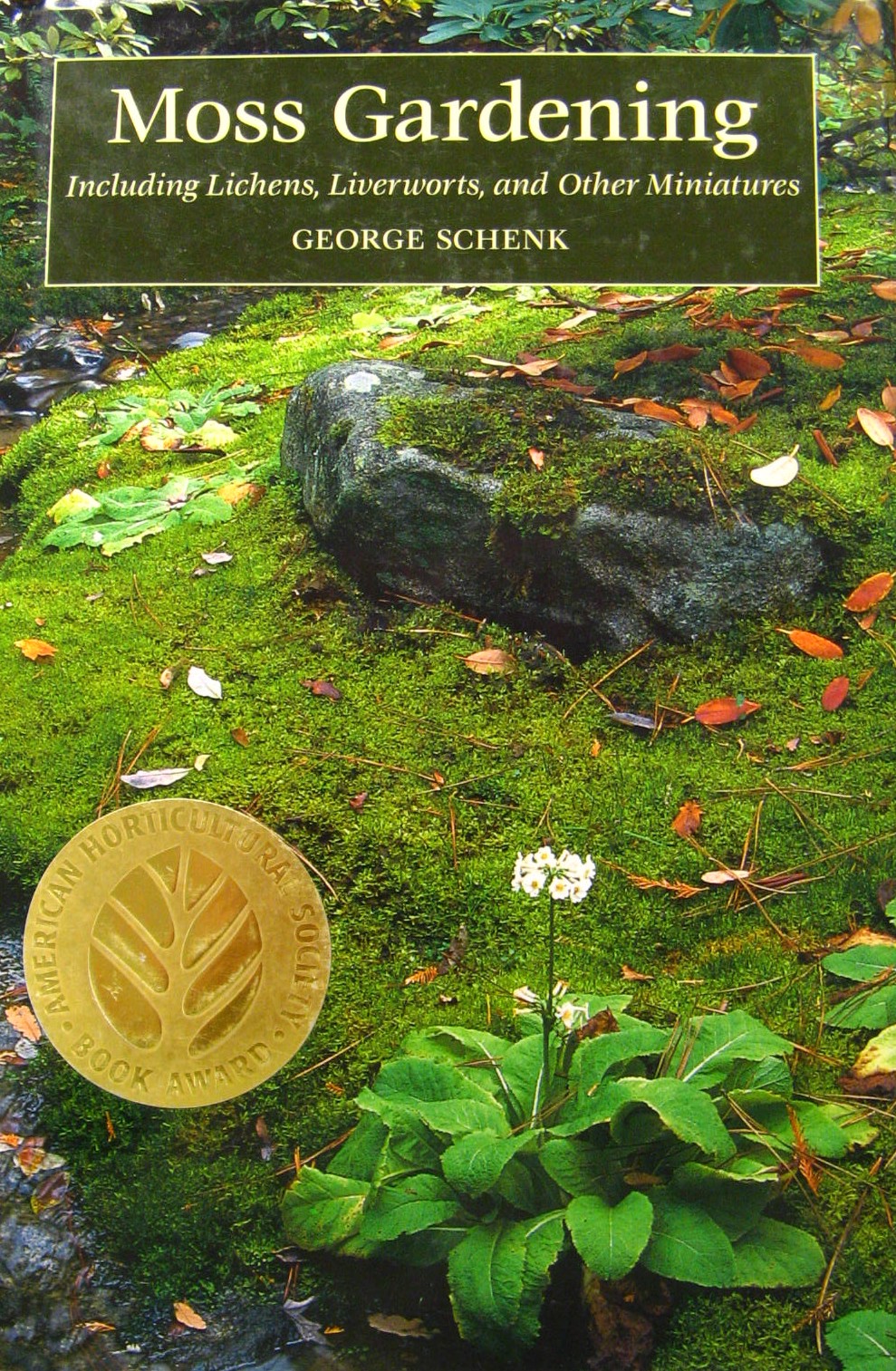
- Schenk, G. 1997. Moss Gardening: including lichens, liverworts and other miniatures. Timber Press: Portland, Oregon.
A good reference book for landscaping/gardening with mosses that is filled with
nice color photos. It also covers growing specifics for particular species. My only critique of the book is that it could use a little more focus on issues of conservation.

- Cullina, William. 2008. Native Ferns, Moss, and Grasses: From Emerald Carpet to Amber Wave, Serene and Sensuous Plants for the Garden. Houghton Mifflin Harcourt.
This book has been on my wish-list for a while, but I have yet to purchase/read it. So I am not sure how helpful it is, but it does have an entire section on gardening with mosses.
If anyone has read this book and has an opinion on its utility for moss gardening, feel free to let me know.

Thanks for all the moss gardening questions and I hope that my answers were helpful. If you have any other suggestions for good moss gardening resources please drop a note in the comments section.

Mosses on Science Friday

While doing some lab work today I was listening to a podcast of Science Friday from NPR. They mentioned a new web-video that had been posted about moss landscaping. I have posted it below or you can click here to check out the video at the SciFri website.


It is a nice video and has some good information if you are interested in encouraging mosses to grow in your yard. I especially like the hand drawn graphics that illustrate moss rhizoids. All of the science they discussed sounded solid. I think that they did their fact-checking well, which is always nice to see.

Typically when I meet people and tell them that I study mosses people respond with, "Oh, I have moss growing in my yard. Do you know how I can get rid of it? " I could start to outline all the ways in which mosses are fabulous and why you would never want to eliminate them. However this usually does not sway people. Instead I say, " Yes I know what you will need to do. 1) You need to change the pH of the soil by adding lime, but it is hard to do that for any large area and you might then need a lot of lime. 2) You probably have a wet area with poor drainage, which you need to fix to make the soil drier. And 3) you should cut down all the trees in your yard. The mosses will not be able to handle the sunlight and the grass will grow better. " This last statement usually results in a jaw-dropping reaction from most people and a statement that they could not possibly cut down their trees. Then they are much more open to learning to love, like or tolerate the mosses. I then go on to tell them that moss landscaping is becoming more and more popular and they should join the trend.

They also make the same the three points in the video. That pH, water, and sunlight are the main things to consider when trying to convert your lawn into a moss covered area. I also second their point about the low-maintenance nature of a moss lawn. By not requiring a weekly mow a lot of fossil fuel energy can be saved. What do you think, is a moss lawn in your future?

Mosses in a Magazine

An article came out this month in the New Life Journal about gardening with mosses. This article was written by of Mountain Moss in North Carolina.

The article has some good moss biology tucked among the gardening tips. She discusses the fact that mosses do not have roots and instead have rhizoids to attach them to the soil. Also she touches on the fact that mosses do not have xylem cells to move water inside their plant body.

Another interesting tidbit that she shares is that mosses can even be seen in the 5000 year old gardens in Kyoto, Japan. I linked to the article that she cited, because I was interested to see if they were talking about the moss temple (Saiho-ji). I visited this temple while I was in Japan this past summer and I was excited to hear what they had to say about it. (Click here for a link to my post about the Saiho-ji temple in Kyoto.)


I was surprised to discover that the Smithsonian Magazine article that she cited did not mention the Saiho-ji temple. Instead it focused on the Ryoan-ji temple (the temple of the peaceful dragon). The focal point of this temple is a zen rock garden that has a number of rocks and mosses surrounded by raked stones.

This is one of the temples in Kyoto that I visited in addition to the Saiho-ji temple. There were not nearly as many mosses as the moss temple, but being that it was a zen aesthetic, less is more. The zen rock garden was very peaceful looking place and my photos capture its true essence.

However being there was quite a different exprience. All the visitiors to the garden sit on a large wooden porch overlooking the area shown here in the photos. You might think that everyone would be sitting quietly meditating as they stare at the stones. If that is what you imagined then you would be wrong. It is more like 40 foreigners sitting on the porch chatting loudly, some of them talking on their cell phones, while the zen stones stare back in dismay.


I was really surprised that they didn't have some sort of talking rules to encourage a meditative atmosphere. Oh well, I will just have to enjoy the meditative experience from my silent photos. It's a little sad that they are better than the actual experience, but I am glad to have gone and given it a try.

Saiho-ji Temple: The Moss Temple

While in Japan I visited the city of Kyoto and the Saiho-ji Temple. This is a Buddhist Temple that has approximately 120 different species growing on the grounds. Reservations are required and there is a 3000 yen fee, but it is well worth the money.

The mosses were a little crispy, seeing as how I visited during the dry hot part of the summer. I think that this temple would be even better to visit during the rainy season in the spring and earlier summer. I am not quite sure that I saw 120 species of mosses, but they covered all the available surfaces on the grounds.

One of my favorite parts were the grounds keepers who were sweeping the leaves off of the mosses and keeping them tidy. They were using traditional brooms, which I thought was a great touch. I would highly recommend it as a great place to see mosses, if you are ever in Japan. However it is not the place to go collecting. I had the urge to put some of the moss in my pocket, but I thought that would be frowned upon. So I resisted and instead took many photos to remember the visit.


A tree base surrounded by
Leucobryum sp.


Mosses in the News

Mosses were featured in the New York Times, Home and Garden section last week in an article entitled "Moss Makes a Lush, No-Care Lawn" By Jancee Dunn. It is a nice article and features some fun pictures such as moss growing on an old pair of gym shoes! I have seen mosses growing on a number of discarded items in the woods, but this is the funniest one that I have seen. She talks about the increasing use of mosses in landscaping and gardening in the eastern United States.

They also feature some mosses of Connecticut and mention a local farm that sells moss for use in landscaping and gardening. I have talked about this farm in a previous blog post. It is the Sticks and Stones Farm in Newtown, Connecticut.

There is one fact issue in this article. They state "There are approximately 12,000 varieties of moss in North America ... ". Now I am not sure what they mean by 'varieties'. Do they just mean species, or species and sub-species, or is it really vague and maybe they are talking about all the different color varieties moss comes in? I am not sure what they really meant but basically they got their value wrong. The latest numbers are that there are 12,000-15,000 moss species worldwide! North America has many fewer. The latest treatment on the mosses of North America is through the Flora of North America Association. The three volumes on North American bryophytes will cover 1,900 mosses, liverworts and hornworts, with probably about 1200 to 1500 of those being mosses. So the NYT article might just have been off by one zero, but that order of magnitude makes a huge difference in the number!

Otherwise the article is well-written and talks about moss gardening from a variety of angles. I would highly recommend reading this article if you are thinking about gardening with moss. It might just get you hooked.

Mosses on TV

I was watching television yesterday after dinner with my family and saw a program featuring mosses. Okay, maybe featuring is a bit of an exaggeration, but mosses were mentioned a couple of times and how often do you see mosses on TV anyway. Needless to say, I was pretty excited!

The show that we watched was on PBS entitled Playing with Trains in the Garden. The segment featured Paul Busse who is a landscape architect using natural materials to build public garden exhibits that feature replicas of local buildings and miniature working trains. The show went behind the scenes to his workshop in Kentucky where the displays are built. They showed how the raw materials, such as moss, are collected from the forest and then assembled by his team to make the displays. It is quite the process and his team is made up of really great artisans! They used the moss to fill in any cracks or chinks in the buildings. One artisan had a great line about moss, (paraphrased, I am not good at direct quotes from memory.) 'Mosses fill up all the little spaces and hide the blemishes. I wish that I could use moss in all areas of my life.' That was the best moss comment the entire show and a nice sentiment as well.

I also looked around online to find a video of Busse's displays. There are several videos on his company's website, Applied Imagination and many photographs of the displays that they have made. I also found a video on YouTube entitled Busse's Enchanted Express by Randy Walk at the Columbus Dispatch. It is a really nice video and features the display at the Franklin Park Conservatory. The version from YouTube is posted below the fold.


Journal Article on Growing Moss Plants

Blogging on Peer-Reviewed ResearchWhile thinking about growing mosses from scratch I remembered a helpful article that I read a while back by Dr. Jonathan Shaw. The article discusses techniques for growing mosses on soil. One of the most interesting methods that he used was a blender to grind the plants up. The plants were kept moist by an automatic misting machine, not by individual domes as I use to grow moss. He found that the mosses began to form protonema in two weeks and within three months the pots were full of leafy gametophytes.

Protonema are a plant growth stage that is unique to mosses. When the spores find a suitable location to grow they do not immediately produce leafy gametophytes. First they make a filamentous growth stage that is reminiscent of green algae. From the protonema numerous gametophytes are produced. Thus one spore can produce many leafy individuals that are genetically identical. In most species the protonema die off and the leafy plants are no longer connected. The protonema pictured here are from the moss Aphanorrhegma serratum, which I grew in the lab.

Overall I think that this is a really good article and I would recommend it for anyone who is growing mosses for research or gardening purposes.

Shaw, J. 1986. A New Approach to the Experimental Propagation of Bryophytes. Taxon 35(4):671-675.

Here is a list of the moss species that Dr. Shaw was able to grow using the methods outlined in his journal article.


Atrichum angustatum
Brachythecium salebrosum
Bryum argenteum
B. bicolor
Climacium americanum
Ditrichum lineare
Isopterygium pulchellum
Leucobryum albidum
Scopelophila cataractae
Thuidium delicatulum
Weissia controversa
W.sharpii

Growing Mosses in the Laboratory

Here is a shot of the light cart that I am growing my mosses on in the lab. Dr. Schlichting graciously lent me this awesome piece of equipment. It has three banks of lights, one of which I am currently using. I am in the process of expanding my moss research colony so that it will soon occupy all three levels. The lights are on a timer and are set for 12 hours of sunlight and 12 hours of darkness. The mosses had plenty of light during the summer sitting out on the windowsill, but with the winter months the needed more light to achieve optimal growth.

The soil on which I am growing my mosses on is a mix that is made in the EEB Plant Growth Facilities at the University of Connecticut. We have spectacular greenhouses on campus and a great greenhouse staff! If you are ever in the area you should stop by to visit the greenhouses. They are free and open to the public.

The recipe for the soil mix is as follows:

Rich Sandy Loam
3 gal. loam
71/2 gal. peat
3 gal. leaf mold
3 gal. sand
10 Tbs. lime

The quantities are pretty large. They mix this up in the greenhouse and store it in garbage can sized containers. Scaling back would probably be best for at home use.

Growing plants indoors in the winter

If you decide to start landscaping with some local moss and want to start some indoors over the winter to plant out in the spring I have some recommendations. Typically moss does not require much sunlight. That is why it is usually found growing in shady areas of the lawn. If you are planning a pot full of moss to add to your indoor houseplant collection, no additional light is needed. However if you are planning to grow moss in bulk to plant outside later, additional light during the winter is a good idea.

For lighting at home I recently purchased a grow lamp for my cactus. It is a totem pole cactus (Pachycereus schottii var. monstrosus) that I bought as a souvenir from the Arizona-Sonoran Desert Museum when I was visiting Tuscon last spring. If you ever have a chance to visit it is a great outdoor exhibit of plants and animals. Not much moss on display, though there are desert species of moss. During a Connecticut winter, the light is not very strong and I thought that my cactus could use more brightness. This cactus is quite the crazy mutant! It lacks spines and has a few small bristles, basically none that can hurt you which is a great feature. I also think that the overall bumpy shape is great! This type of cactus is native to the Baja California Peninsula portion of the Sonoran Desert.

Overall this grow lamp is working out well for my cactus and I think that it would be good to stimulate indoor moss growth as well.

Growing Moss

I have been thinking about moss gardening lately and the challenges associated with this pastime. Questions have arisen such as: What do you do when there is no landscaper in your area to purchase moss from and you want to grow local species? One technique that I have been using in the laboratory might also work for those who wish to garden with moss.

I am growing mosses in these little plastic containers (see photo) with the edges sealed by plastic wrap. I think that larger seed starter trays would work as well. The main item of importance is that they have a lid so that the moisture does not escape.I have started mosses on soil in two ways.
1) I sprinkle spores out of a capsule onto the soil.
2) I take leafy gametophyte plants and grind them in some water using a mortar and pestle. Then I apply the moss slurry onto the soil surface.
In both cases I add some water and seal the lids. In several weeks the leafy gametophytes begin to grow.

I currently have my mosses growing on a light cart that gives them 12 hours of light a day. During the summer I have them sitting in a windowsill in the lab with no additional light.
I am currently growing three moss species on soil in the lab (Funaria hygrometrica, Physcomitrium pyriforme, and Physcomitrella patens). I have not tried this technique with other species, but I have confidence that it would work. If anyone decides to give it a try I would love to hear about the results.

More comments on moss gardening to come!

Think Local

Ideally when landscaping with any plants, including moss, you will want to find a local retailer that is selling native species. Those are species that naturally occur in your area. These plants have not been introduced purposefully or accidentally by humans into the wild. Not that there are any aggressive invasive moss species. (I don't know of any invasive mosses off the top of my head, but I will look into it more.) Needless to say, you do not want to be the first person to release the moss version of purple loostrife or kudzu into the wild, which are both invasive species in North America. It is also important that retailers you might buy moss from are growing it themselves. Removing large patches of moss from the wild and then selling them is bad. They should have actively growing populations of mosses that they are propagating to sell.

If you live in Connecticut, or in the surrounding small states, I have heard of a place to find mosses to use in the garden. The retailer is Sticks and Stones Farm in Newtown, Connecticut. I have yet to visit personally, but it comes highly recommended. They sell seven different species of moss that can be ordered online. Moss is grown in flats outside and they do not poach from the wild, which gets a two thumbs up from me. If anyone has visited the farm I would love to hear your thoughts or comments on your experience. I will definitely let you all know if I have a chance to visit.

Moss Gardening Book

This is the book to have if you are interested in using moss in your garden. There is not another book quite like it or any alternatives. Overall I really like this book. There are great photographs throughout the book. It begins by introducing you to mosses in a biological manner and points out what things are and aren't moss. That is where I usually start when giving a presentation about moss and I think that it is a good approach. He transitions into the history of moss gardening both in Japan and in Western countries. Good locations for growing moss are discusses as well as propagation techniques. My favorite chapter is Chapter 14, entitled Portraits. This chapter introduces the reader to 70 different species of moss, lichen, and liverwort. There are brief descriptions of the species and the habitats in which they grow. Fun facts and antidotes about some of the species are also included.

The main thing that this book is missing is a section on conservation. Encouraging people to garden with moss is great! But it is also important to encourage people to be good stewards of the moss that grows wild on their property or in surrounding areas. Removal of small pieces of mosses (think the size of a quarter or dime) from an area will most likely not damage the moss community. However large patches of mosses should not be removed from any surface, either tree bark, stone, decaying wood or soil. Basically large patch removal (saucer to dinner plate size) is the equivalent of strip mining in the moss world. If more moss than a small patch is needed to transplant or make a moss slurry (see pg 158 in the book), I would recommend collecting patches from several different places across a larger area. That way there is moss close to the open patches that can grow to fill the space. I think that conservation and stewardship are important topics to think about in the context of gardening with moss. I hope that everyone who gardens with moss or enjoys them in the out of doors will also think of what they can do to protect and care for these great little plants.

Moss Gardening: Including Lichens, Liverworts and Other Miniatures By George Schenk