Field of Science

Showing posts with label research. Show all posts

What's inside a spore?

Moss spores are small single celled packages that play a crucial role in establishing new populations. These tiny units are blown by the wind and then landing somewhere suitable, grow into a new moss plant. They enable mosses to spread far and wide across the globe. 

There are two strategies for releasing spores. 

Xerochastic = capsules are open and spores are released when conditions are dry.

Hygrochastic = capsules are open and spores are released when conditions are wet.

We might expect to that plants with different strategies for spore release also have different types of spores. Maybe those that are released during wet conditions are primed to develop more quickly and those released when it is dry have more long-term energy storage to increase their survival until conditions are good for growth. 

In a recent study, Nagore Medina explored the question of whether spores have different characteristics between those that have xerochastic vs. hygrochastic dispersal in seven closely related Orthotrichum species. She used Transmission Electron Microscopy to examine the spore ultrastructure to determine if there were any differences between the species.

She found that the two hygrochastic species that disperse when conditions are wet have slightly smaller amounts of lipids inside. Think of the lipids as fat storage that helps the spores make it through tough times when they are not producing new food. This points toward these spores being less prepared to survive long-term out in the world prior to growing. 


Also the hygrochastic species have higher proportions of bicellular spores. Usually spores are just a single cell, as I mentioned earlier, but of course in biology there are always exceptions to the rule. Life is gloriously messy like that! They interpret the bicellular spores as a sign of early germination. Think of these spores being ready to hit the ground growing. They are so prepared that they already started dividing to produce more cells. 

Examples of this spore difference are visible in the images below. The two on the left have bicellular spores. There is a thin line running through the middle of the spore labeled "CW" indicating where a new cell wall has formed separating the two cells on either side. The spores on the right are each composed of only a single cell.

From Medina & Estébanez 2014. Transverse sections through the spores.
Two hygrochastic species on the left. Two xerochastic species on the right.
Upper Left: Figure 1C.  Lower Left: Figure 4C. Upper Right: Figure 6D. Lower Right: Figure 7D.

These are the main differences that they found between the spores of hygrochastic and xerochastic species. Unfortunately no other significant differences were found between the spores. But that is how it sometimes goes with science. Scientists come up with an interesting hypothesis that predicts a particular pattern and you find a bit of data supporting your prediction, but not nearly as much as you had hoped to make a very strong conclusion. Instead there is a bit of evidence supporting your idea, which may be just enough to keep you trying out the next experiment to see where the explorations will take you. 


Nagore G. Medina & Belén Estébanez. 2014. Does spore ultrastructure mirror different dispersal strategies in mosses? A study of seven iberianOrthotrichum species. 9 (11): e112867.

A Symposium on Southern Hemisphere Bryophytes

This past January I attended the 2015 conference of the International Bryological Association in southern Chile. It was a great conference and an amazing location to visit!

The symposium advertised below may only be of interest to professional bryologists, but I would highly recommend that anyone looking for a far off vacation adventure that is loaded with bryophytes consider visiting Puerto Williams on the Island of Navarino. A unique piece of traveling to the end of the world is a 30 hour ferry that takes you from the mainland to the island. On the trip nature abounds. Whales, birds, and glaciers are just a few of the amazing sites to see!

On the Dientes Circuit - January 2015
While there I also went on a spectacular 5-day backpacking trip on the island (Dientes Circuit). It was an intense hike through sunny hot valleys, up an over cold windy passes, skiing down mountains on loose rocks, and slogging through piles of mud. A fabulous way to escape civilization and interact with nature! 

For nature lovers who are not adventure seeking backpackers, the Omora Ethanobotanical Park is a wonderful natural spot that has beautiful plant and bird life. There is a interpretive trail that introduces you to the common bryophytes of the area. Additionally there are even several pairs of Magellanic woodpeckers that live in the park and researchers are actively studying. I went out to try and see them a couple of mornings but no luck. I think this means I will have to go back to southern Chile to add them to my birding life-list!

--------------------------------------------------------------------------------------------

VIII Southern Connections Congress January 18th - 23rd 2016
Punta Arenas, Chile
Symposium: Phylogeography & Ecology of Bryophytes in the Southern Hemisphere

Bryophytes are one of the most important components of high latitude floras in terms of diversity, abundance, and ecological function playing key roles in primary succession, water retention, terrestrial carbon sequestration, and nutrient cycling. At high latitudes bryophytes contribute disproportionately to regional biodiversity, with the Antarctic flora composed almost entirely of bryophytes, and the southernmost tip of the Americas hosting 5% of the world bryophyte diversity on just 0.01% of the earths terrestrial surface. Over the last decade, molecular tools have dramatically shifted paradigms of bryophyte evolution, ecology, and biogeography both globally and in the Southern Hemisphere. Here we bring together cutting edge research on bryophyte phylogeography and ecology in order to highlight the key processes driving diversification, richness, and biogeography of bryophytes across ecosystems and timescales in the Southern Hemisphere.

If you are interested in presenting within, or have questions regarding the symposium please contact the organizers:

Symposium Organizers
Elise Biersma (Cambridge University & British Antarctic Survey, UK, elibi@bas.ac.uk)
Dr. Lily R. Lewis (University of Connecticut, USA, lilyrlewis@gmail.com)

Congress Website & Registration: http://southernconnection2016.com/congress/


Bryophyte Research Podcasts


The American Bryological and Lichenological Society (ABLS) has started a podcast to feature current research on bryophytes and lichens directly from the experts. 


Episode 1 focuses on transcriptomics. Let me try to break this down for you. Transcripts are small messages (mRNA) that are copied from the DNA and are used as templates to make proteins. -omics refers to a field of study. So transcriptomics is the study of transcripts. When you compare the transcripts from different organs or different developmental stages it can point toward genes that are turned on and off between the two, indicating those genes that potentially make them different.  

Episode 2 is about the sex lives of bryophytes and lichens. Fortunately no explanation on the topic is needed there. 

The Genetics of Resurrection Plants

A great article from KQED Science about resurrection mosses. Scientists are learning more about these tough plants with the goal of using their genes to improve crop plants, so that they can better survive the drought conditions in California. 


Professional Website Update

I finally got around to revising my professional website. It was way out of date and could use some sprucing up. I originally had some large ambitions to switch to a Wordpress site with a sharp theme, but the learning curve was just too steep for me at the moment. So instead I just made some changes to my iWeb site and posted it up. 

The only issue I keep running into with this platform is that the spacing is difficult to get right. Something about the way the formatting is automatic and my inability to see behind the scenes to tweak it. If you have any other suggestions for different website platforms that you like it would be great to hear about them!

A Science Blogger Survey

Have you ever wondered why people write science blogs? In the age of Twitter and Instagram are science blogs still popular? Is science blogging dying out? Does anyone actually read them? Feedback from readers can sometimes be few and far in between. As the writer of a science blog it sometimes feels like I am shouting into an internet void. Is anyone listening?

I recently participated in a survey that went out to science bloggers about this very topic. I was excited to participate in someone's dissertation research and interested to see what came from the survey. The research is being conducted by Dr. Paige Brown Jarreau (@FromTheLabBench) at Louisiana State University. She is disseminating her data and results using open access platforms that enable us to see behind the scenes and to check out the research results prior to formal scientific publications. 

So what information does she have out there for us to explore and what can we learn from her study about science blogging?

Brown, Paige (2014): MySciBlog Survey - 
Top Read SciBlogs by SciBloggers. figshare. 
http://dx.doi.org/10.6084/m9.figshare.1278974
Part of the research involved determining the connections between science blogs. Answering questions like, as a science blogger which science blogs do you read? Or who are the science bloggers that follow your science blog? Interesting questions, but how do you display this type of data once you have the information? Here Paige walks you step by step through the process of using data to map a social network.

The best part in my opinion is this interactive network available on figshare. You can zoom in on different parts of the network and see how connected each of the science blogs and bloggers are to others in the community. You can find Moss Plants in Group 8. The black cluster in the lower right corner. I follow other science bloggers, but no one else in the survey follows my blog. A bit disappointing, but potentially to be expected. Another interesting pattern that you can see from this graphic is the highly connected red blog on the left side. That is blog Not Exactly Rocket Science from National Geographic. It looks to be very popular among science bloggers and might be one that I need to check out to see what it is all about. 

The slides from Paige's dissertation presentation walk you through the big picture and major findings of her research. She also breaks the research down point by point in this blog post.


For some additional reading on this project check out Paige's blog post that argues using her data that science blogs are not dying. Thank goodness! My posting has become more monthly rather than weekly these days and I was pondering whether or not I should keep it up. For now I am still in for blogging, but I am contemplating inviting some colleagues to guest post. So if you know of anyone who is interested in practicing their science communication skills and writing posts about mosses just drop me a message. 

Jurassic Park Mosses


Imagine the world millions of years ago. Covered in plants and dominated by dinosaurs. 

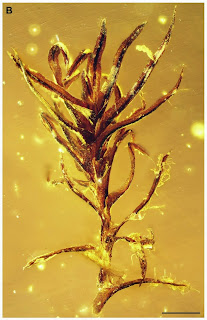
Mosses were a critical component of the lush green background, but you wouldn't know it from the fossil record. Unfortunately there are not many moss fossils. They break down more rapidly than other woody plants and thus there is less fossil evidence of their history on the planet. 


Calymperites burmensis sp. nov. 
fossilized in amber. Heinrichs et al. 2014

Finding new moss fossils, especially well preserved ones, represents an important scientific discovery. Recently a new species of moss was described from a plant found in amber (fossilized tree resin). Originally this piece of amber was intended to be a necklace, but now lives at the American Museum of Natural History in New York where it can be studied by scientific researchers and potentially viewed by the public. 

The closest living moss relatives to this fossil moss were determined based on its physical features. Based on this data, the species is in the moss family Calymperaceae. No DNA was mined out of this preserved specimen. Unfortunately recovering DNA from amber fossils only happens in the science fiction of Jurassic Park.

Fossils, like this one, are an important addition to our scientific knowledge. They help us to determine the timing of moss evolution and to date evolutionary trees. This gives us a better understanding of when particular groups evolved and which groups were present during the prehistoric times of the dinosaurs.


For more on ancient plants, check out this episode of Plants Are Cool Too!

More than just Mosses


My life as postdoctoral research fellow at the University of California, Davis is more than just mosses. I am also an active member of my postdoctoral union. The union has a number of roles such as giving postdocs a voice to maintain good pay rates and healthcare benefits, facilitating professional development with panel discussions and computer programming workshops, and creating a social network through mixers and BBQs

Yes, it does cost some money to be a union member. For me it is about $30 in fair-share fees and $10 in membership dues per month, but I think my contributions are going to good use. Besides helping UC postdocs to get a pay raise this year, I am happy to say that my contributions have helped to support the graduate students at the University of Connecticut to unionize. I earned my PhD in 2011 studying bryophytes in the Ecology and Evolutionary Biology Department at UConn and thus I am particularly invested in the university maintaining a strong graduate program that continues to produce amazing science and great researchers.

Having competitive wages relative to the cost of living and good benefits were some of the factors that drew me to the University of Connecticut for graduate school. I was also considering and accepted at UC Berkeley, but at the time they were paying less than UConn and had a much higher cost of living.

I hope that the University of Connecticut will move forward with contract negotiations with the graduate students. From the latest updates, it sounds like the process is being delayed and dragging on longer than necessary. The graduate students and the university have better places to spend their time and resources than on prolonged negotiations. 

I hope that the University of Connecticut will value and compensate graduate students fairly for all the significant contributions that they make to teaching and research at the university. Graduate students teach many of the laboratory and discussion sections, as well as designing and carrying out research that results in top notch publications. Just check out graduate student Lily Lewis's publication on bird dispersal of bryophyte diaspores or Manette Sandor's research studying the influence of remnant trees on tropical forest regeneration. Lily and Manette are both great scientists and their continued success is as graduate students is dependent upon the university agreeing to a contract that establishes standards for fair pay and benefits. 

Add your support to the graduate students at the University of Connecticut by signing this petition. Click here for a link to the petition. 

You can also follow the UConn grad student union @GEUUAW or through their website http://www.uconngradunion.org/.

A Science Communication Activity on Birds and Bryophytes

Have you ever played the telephone game? In this game a phrase is whispered from one person to another with the players trying to repeat the phrase exactly the same. By the time the phrase makes it to the other end of the line it is often altered, sometimes dramatically so. The same can also happen to research as it is transmitted from a peer-reviewed scientific article to the popular media, such as a magazine or newspaper. One explanation for alterations to the research story is that scientists use language with lots of jargon and scientists often use many words that are qualifiers. Qualifiers are words that limit or enhance the meaning of another word. Most often when scientists use them it is to explain the scope and limits of their findings. All-in-all the language of science is significantly different from the language the news media uses to communicate with the public and the weight that is given to different terms and phrases varies between the two.

I think that science communication is an important concept for students who are training to be scientists to both ponder and explore. Thus I developed a team-based learning activity to walk students through the exploration of a scientific research article and the news media reporting on the findings. The main learning objectives of this exercise are for students to: 
-   Analyze the transmission of information from scientific publication to news media.
-   Identify absolute versus qualified statements.
-   Differentiate different organisms from bryophytes.

An additional goal of this exercise was to introduce students, potentially for the first time, to a scientific research article. Reading peer-reviewed research from beginning to end can be intimidating for science students. This activity has students explore the research article for information to compare to the news articles, resulting in students both learning how to find information in scientific papers and how to ground-truth science that is reported in the media.  

If you are interested in trying out this activity with your students I posted the materials that you will need online, via Google DriveIncluded in the materials is a detailed lesson plan, as well as a pre- and post- assessment (with a key) to measure student learning from the activity. Alternatively this activity can be modified to focus on any scientific paper from your field that has been covered in multiple news articles. 


The article that I used for this exercise was a publication studying whether migrating birds may be responsible for moving pieces of bryophytes from northern arctic regions to the far southern reaches of South America. 


The research article can be downloaded for free at the link below. 

The news articles covering this research are at BBC Nature NewsAudubon MagazineScience MagazineUConn Today, and Alaska Dispatch News.

If you use this activity with your students, it would be great to hear your thoughts about the exercise in the comments section below the post!

Microscopy for the Masses

Microscopes are amazing tools! I had a small plastic one as a kid and I loved exploring items I collected outdoors. Parts of plants, a scoop of soil, basically anything I could get my hands on I mounted up on a slide and looked at under my microscope. That is one aspect that drew me to study mosses. Microscopes are an essential tool to identify moss species and the closer you look at mosses the more amazing features you uncover!  

My family is well aware of my love of microscopes and my sister recently sent me a link to this TED talk about a microscope made almost entirely of paper that costs around 50 cents to produce. It is a really inspirational talk and I think that these scopes are going to revolutionize microscopy. 


I completely agree with the assessment that traditional microscopes are much too bulky for the field. When I head out to collect mosses I don't take my microscopes with me. I bring the mosses back to my microscopes, which stay at home or in the lab. I think that foldscopes would be a great way to take moss identification into the field and enable identification to species without bulky microscopes or having to wait until returning to the laboratory. 

I thought about submitting an application for the 10,000 Microscope Project, focusing on outreach to the public and exploring mosses in the field, but life became busy and it slipped off my priority list. I will definitely have to get a proposal put together for the next round of testing. I think that these scopes would be a great way to introduce people to mosses and enable exploration and identification without a costly setup. 

The Color of Light

Sunshine, to our human eyes the light appears white, but buried within are all the colors of the rainbow. In order for you or I to detect the colors that compose white light we need help. Shining light through a prism is one way I know to separate light into its many colorful components. Plants, on the other hand, need no such help. They have proteins called photoreceptors that enable them to detect different wavelengths of light. There are several different types of photoreceptors. Phototropins sense blue light, phytochromes sense red light, and neochrome is a chimeric protein that has the ability to sense both blue and red light. 

Light, especially the blue and red portions, are the main types plants use to run their photosynthesis machinery. When taller plants shade out shorter plants they alter both the quantity and quality of the light that reaches the plants below. Thus it is important that plants can detect the light quality in order to respond appropriately, by either growing away from shady spots or altering how they develop. 

A few ferns hanging out with their mossy pals.
A recent study was published that literally sheds some light on the evolution of these light sensing photoreceptors. Neochromes, the light sensing proteins with dual abilities, are present in only two groups of plants, the green algae and the ferns. Previously, scientists thought that these two groups independently evolved neochromes. But this new research proposes a different explanation. They found that the hornworts, a small group of bryophytes, also have neochromes and their proteins are closely related to those in ferns. They are so similar in fact that they were most likely transferred from hornworts to ferns. 

Horizontal gene transfer is a pretty wild thing that can happen in biology. One organism, potentially distantly related to another, can transfer some of its genetic code to another organism. If it is helpful the organism will keep the new piece of DNA, use it, and pass it on to its offspring. Scientists think that neochromes were very useful for ferns. Growing in the shadows of taller flowering plants, neochromes enabled ferns to take full advantage of low light conditions, thrive, and diversify. I think the ferns should send a thank you note to the hornworts for that super useful gift. The transfer of neochromes from one to the other happened over 150 million years ago, but you know what they say, better late than never.

Fay-Wei Li, Juan Carlos Villarreal, Steven Kelly, Carl J. Rothfels, Michael Melkonian, Eftychios Frangedakis, Markus Ruhsam, Erin M. Sigel, Joshua P. Der, Jarmila Pittermann, Dylan O. Burge, Lisa Pokorny, Anders Larsson, Tao Chen, Stina Weststrand, Philip Thomas, Eric Carpenter, Yong Zhang, Zhijian Tian, Li Chen, Zhixiang Yan, Ying Zhu, Xiao Sun, Jun Wang, Dennis W. Stevenson, Barbara J. Crandall-Stotler, A. Jonathan Shaw, Michael K. Deyholos, Douglas E. Soltis, Sean W. Graham, Michael D. Windham, Jane A. Langdale, Gane Ka-Shu Wong, Sarah Mathews, and Kathleen M. Pryer. Horizontal transfer of an adaptive chimeric photoreceptor from bryophytes to ferns. PNAS, published ahead of print April 14, 2014, doi:10.1073/pnas.1319929111

Additional coverage of this research can be found at these links: National Geographic, ScienceDaily, and The Economist

For more on plant colors, check out Johnna's April edition of the Berry Go Round plant carnival. My favorite is the post about the iridescent fruits of Pollia condensate. Pretty cool that they are the shiniest living things on Earth!

Zombie Mosses Rise Again

Rising from the depths, mosses that have been frozen in suspended animation for hundreds of year grow again! You may recall that zombie mosses were in the news last summer, well they are back. In this study, published last week in Current Biology, mosses were dug up from an island in Antarctica and regenerated new plants in the laboratory. Digging up and growing mosses is typically not a news-worthy activity. The amazing thing about these mosses is that they had been buried in the permanently frozen ground (permafrost) for the last 1,500 years, since Roman times.

This story was covered by a variety of news sources. By far my favorite was Jennifer Frazier's coverage for National Geographic. She did a great job of discussing the science and soliciting comments from scientists doing similar research. For an audio clip of the story, I enjoyed the 60 second science podcast from Sophie Bushwick at Scientific American. 

Let's put this study in perspective. Mosses can survive freezing. This is a known ability. Mosses are buried beneath the snow during winter in many places across the globe and each spring they thaw and resume growth. This study pushes our knowledge of this phenomenon to the extreme and leads to some questions. 

How long can mosses survive frozen and recover? In the National Geographic article, Dr. LaFarge mentions that they have an upcoming study to test whether 50,000 year old mosses can resume growth. There will most definitely be more to come on this topic.

What are the compounds inside moss cells that act as antifreeze, helping them to prepare for and survive freezing? I know that I have read a paper on this somewhere. My memory says that they are called LEA proteins, but I can't recall which paper discussed them relating to mosses. 

Can all species of mosses survive this long? Thinking ecologically, my guess would be that mosses from the tropics would not be able to survive frozen for even a single winter, let alone hundreds of years. Whereas, thinking systematically, the mosses that grew from 400 years ago (LaFarge et al 2013) were from four different moss families (Aulacomniaceae, Encalyptaceae, Ditrichaceae, Pottiaceae) and the one in this study is from a different family, the Dicranaceae. From this small sample it looks like surviving frozen for extended periods of time is a feature of many groups of mosses. 
Figure S1 from Roads et al. 2014.Chorisodontium aciphyllum moss bank sampled in this study; 
(a) map of Signy Island indicating the study location; (b) coring the moss bank;
(c) surface section of clearly separable gametophytes;

(d) fresh-collected section of core from within the permafrost layer.


This supplemental figure from the paper gives you a peek into some of the research methods. The upper right shows the researchers collecting mosses in the field. The lower right is a freshly collected core of mosses. It is amazing how compact the sample appears. It looks like a solid metal rod, but really the bottom left is a pulled-apart version of the bottom right. 


I am looking forward to the next tale of zombie mosses from LaFarge and colleagues. 
Can 50,000 year old mosses grow again? 

Deep Fried Moss

I was incredibly excited to find out about the Danish* restaurant Noma serving fried moss on the menu! My sister heard the story on a podcast from the America's Test Kitchen. In the show, host Christopher Kimball interviews René Redzepi, the chef of Noma, during Segment #2 and the fried mosses are briefly mentioned at the end of their interview. Considering this restaurant is located in Copenhagen* and is on the extremely pricy end I don't think that I will be eating fried mosses there any time soon. But I really wanted to get a look at a plate and I did some hunting around online. 

There are a number of people who have taken photos of their plates and have posted them up online. I didn't want to repost personal photos, so I linked to a few of them that you can check out below.


After looking at a few of the plates did you discover the truth? It is not in fact a fried bryophyte, but is a fried lichen! Oh the mossy-misnomers. One of the common names for the lichen Cladonia rangiferina is reindeer moss and that is the organism that is fried and intended for eating. There are, however, mosses on the plates. Many of the plates look to be covered in Leucobryum, the pin cushion moss. Serving platters are typically washed and reused. Do you think they rinse off the mosses and then used them to serve the next customer. I would hate to hear that they tossed out the mosses after a single serving.


Leucobryum
I also wonder if anyone tries to eat the bryophyte mosses off the plate? If they did, I don't think that they would find them too tasty or with much nutritional value. Not many animals eat mosses. Just a few northern creatures, such as caribou and lemmings. Based on caribou stomach contents, they mainly eat mosses during the winter and probably just to fill hungry stomachs. I remember a great graphic showing the percentages of items found in the stomachs of caribou throughout the year with a spike in the mosses during the winter, but I couldn't locate the study. If this reference rings a bell for anyone please drop a message in the comments. 

* An earlier version of this blog post incorrectly locate Noma in Norway. The restaurant Noma is actually located in Copenhagen, Denmark. Thanks to the commenter who pointed out the geographic error.

Two Structures, One Set of Genes

When presented with a problem it is typically easier to solve it with tools at your disposal rather than inventing something new. This is also the case for plants and animals. When presented with a developmental or evolutionary challenge, it is often easier for them to use genes that already exist in their genetic toolkit to respond to the challenge.

Rhizoids are thin filaments of cells that anchor leafy moss plants onto their growth surface, which can be soil, rock, or trees, just to name a few. Rhizoids also function in water uptake. They help by creating many capillary spaces in which water can be move from the soil to the plant. However, rhizoids are not the only structures that are able to take up water in mosses. The leafy gametophyte plants can absorb water through many parts of their body including leaves and stems. 

The water uptake structures that you are probably more familiar with are roots. They are underground organs that function in water uptake and anchor the sporophytes of vascular plants into the soil. Near the tips of each root there are elongated, filamentous cells (root hairs) that increase the surface area through which the roots can take in water. 

Though root hairs and rhizoids have similar functions and they both start with the letter 'R', these two structures have completely independent evolutionary origins. By that I mean that root hairs are not rhizoids that have been changed and modified over evolutionary time. Another piece of evidence that points to them being evolutionary independent is that rhizoids are only present on the gametophytes, whereas root hairs are only on the sporophytes. Having structures that are exclusive to opposite generations typically indicates that have evolved independently. 

So, root hairs and rhizoids have similar functions, structurally they are both filamentous in shape, but what about the genes that control their development. Might they be using the same or similar parts of their genetic toolkit to build these two structures? 

Scientists examined this by figuring out the genes that are important for forming the root hairs in flowering plants, then looking to see if these same genes are also important for root hairs in mosses (Menand et al 2007; Pires et al 2013). The figure below shows some of their results. Let me walk you through it. On the left are mosses will brown rhizoids growing from the base. On the right are flowering plant roots with thin root hairs sticking out of the sides. WT and Col0 are what the plants look like naturally with no changes to the genes. 


Part of Figure 4 from Menand et al 2007

They found a group of related genes in mosses and flowering plants that influence both rhizoid and root hair formation. Pprsl1, Pprsl2, and rhd6-3 are the names of three members of this group of genes. 

What we see on the left is that they knockout/turn off Pprsl1 = rhizoids still formthey knockout/turn off Pprsl2 rhizoids still formbut when they turn both of them off  = no to only a few rhizoids form. 

On the left, center panel they turn off the gene rhd6-3 and the root does not make any root hairs. The coolest part of the study is that they are able to knock out the gene that makes root hairs, then use the moss gene to control the formation of root hairs. They are using a moss gene to control the production of root hairs in a flowering plant. Pretty wild!

This is just a small part of the story where they show that root hairs and rhizoids are controlled by the same network of genes. I think that it is a great example of plants using the genetic tools at their disposal to build similar structures on completely different parts of the plant in distantly related species. 

Check out the publications for more details about their experiments and findings. 

ResearchBlogging.orgMenand B, Yi K, Jouannic S, Hoffmann L, Ryan E, Linstead P, Schaefer DG, &; Dolan L (2007). An ancient mechanism controls the development of cells with a rooting function in land plants. Science (New York, N.Y.), 316 (5830), 1477-80 PMID: 17556585


Pires ND, Yi K, Breuninger H, Catarino B, Menand B, &; Dolan L (2013). Recruitment and remodeling of an ancient gene regulatory network during land plant evolution. Proceedings of the National Academy of Sciences of the United States of America, 110 (23), 9571-6 PMID: 23690618