Field of Science

Showing posts sorted by relevance for query lichen. Sort by date Show all posts

Cell Phone Microscopy

micro phone lens packaging
and case
In my pursuit of portable microscopy I came across this product initially funded through Kickstarter. The micro phone lens is a small plastic disc that sticks to a cell phone's camera lens, turning it into a 15X microscope. I had to try it out and I thought it would be worth the $15 experiment. 

Case with lens in the
lower lefthand corner.
 
The lens comes in a small container with an eye-catching black and white design on the top. It is great that the whole setup is so portable, but I am in a constant state of nearly loosing it. I have set my phone down, forgetting to have the lens facing up, only to have the lens come off as I picked up my phone. I have dropped it on the floor covering it in dust. And last night I completely forgot to take the lens off when I was finished and found it stuck on the kitchen table when I went to eat my cereal and read my morning dose of The Economist. Maybe it was just a forgetful and slightly klutzy episode of microscopy, but you get the idea. Beware of loosing this small disc that is slightly larger than the O on your keyboard! Fortunately the lens is also quite resilient. It is bendable and can be easily cleaned with water. 


Let me show you what this little lens can do. I pulled out a dried lichen that I collected on a drive into the California coast range. It is the lace lichen, Ramalina menziesii, aptly named for the lacy filaments that increase the surface area of this lichen, enabling it to better absorb moisture and nutrients from the air. 

Ramalina menziesii the lace lichen

I took the photos below with the micro phone lens stuck to my Nokia Lumina 928 cell phone. The lens requires a camera with at least a 5 megapixel camera and mine is 8.7 megapixels. The center of the photos is in crisp focus, but I was disappointed that the field of view is so small and that parts of the lichen near the edge of the image are thus out of focus. The demo on the website has the entire field of view in focus. That video was taken with a tablet whereas mine were with a phone, so it could be that the interaction between the lens and my phone optics are the issue. 

An even closer view of the lace lichen
Up close with the lace lichen


The other issue I had was stabilizing the camera and taking a photo at the same time. The instructions online recommend using the lens case as a platform for the phone when taking photos. This works pretty well, but I ended up needing to tip my phone to adjust the distance to the sample I was looking at since it wasn't sitting flush against the table.


This company is also in the process of developing a 150X lens and just had another successful Kickstarter project to fund it. After my experience with the 15X lens I think I will hold off on purchasing the higher magnification one. More magnification means a smaller depth of field and I think that the 15X lens is reasonably challenging to focus. I bet that the 150X will be even more difficult. I will wait until some reviews come out before jumping on that one. 


Lily flower
Another plant I examined was a lily that I got in a bouquet from the farmer's market on Saturday. Specifically I zoomed in to take a look at the the pollen-covered anthers.


Anther


The 15X lens gets us significantly closer to the pollen than my cell phone camera can without assistance. Still a small field of view, but all-in-all reasonably good for a 15 dollar addition to my magnification arsenal.  
The pollen up close and personal. 

Lichens in the Forests of Norway

Blogging on Peer-Reviewed ResearchSince some of my blog posts have discussed moss gardening in relation to conservation and stewardship, Dr. Elphick recommended an article on lichen conservation. I checked it out and decided to share some of the interesting highlights. (For a review of lichen biology see my posts from October.)

Caruso, A., J. Rudolphi, and G. Thor. 2008. Lichen species diversity and substrate amounts in young planted boreal forests: A comparison between slash and stumps of Picea abies. Biological Conservation 141:47-55.

This study examines the lichens that grow on dead wood in managed forests. The dead wood consists of branches and tree tops (slash) as well as stumps. Forest managers are interested in using this wood for biofuel and this research study explores how this removal will impact the lichen communities.

Out of the 60 species of lichens that were found growing on the slash and stumps, 42 of these species were only found growing on these substrates in the forest. They were not found growing on any of the live trees. Additionally, the stumps had more unique lichen species than the slash. This is most likely due to the larger moisture holding capacity, higher surface area, and greater texture (nooks and crannies) of the stumps. Thus this dead wood represents a important growing surface for lichens and should be taken into account for lichen conservation.

Decaying wood is also a substrate for mosses on the forest floor. I think that it would be interesting to see if many species of mosses grow exclusively on decaying wood similar to lichens. This would lend support to the idea that dead wood should not be removed from the forest floor for biofuel, since it provides a critical substrate for forest organisms.

Some Birds Like the Moss

One of the ornithologists in my department forwarded along this article about Australian woodland bird conservation that mentions mosses.

R.M. Montague-Drake, D.B. Lindenmayer and R.B. Cunningham. 2009. Factors affecting site occupancy by woodland bird species of conservation concern. Biological Conservation Volume 142, Issue 12, Pages 2896-2903.

They focused on  patches of woodland and studied which aspects of the woodland affect the presence of 13 different bird species. One of the factors they measured was the % of the ground or rocks that was covered by mosses and lichens.

They found that 5 of the bird species were more likely to be found in woodlands with high percentages of moss and lichen cover. They lichen-ed them! (Teaching Bryology and Lichenology there were so many bad lichen jokes during the laboratory period, but I still found them totally funny.) 

The authors mention that often in other studies they do not distinguish between 'bare ground' and 'moss and lichen covered'. I would have to agree that there is a big difference between the two. Moss layers hold moisture, prevent soil erosion, and serve as housing for invertebrates and other small critters.

It is great to read that some species of birds thoroughly appreciate their moss and lichen neighbors!

Mosses in Ohio

I recently learned of a moss website of which I was previously unaware. It is the website of the Ohio Moss and Lichen Association. I thought that this was very timely since I am currently on vacation visiting my family in Cincinnati, Ohio, hence the lack of posts for the past week. Also Ohio has a fond place in my heart, since I attended Miami University, Oxford, Ohio for my undergraduate education.

I have checked it out the website and there is some really great information. Here are the highlights.

1) They have yearly forays in Ohio which are announced on the website. The next one will be held on June 21st. So if you are in the area it would be a great way to meet other moss enthusiasts.

2) There is a map that shows the number of moss species per county. The most speciose is Hocking County with 200+ moss species.

3) The part of the website that will be of the most interest to persons not in Ohio is the Introduction to Moss Identification. This guide does not assume any previous moss knowledge and starts by discussing how mosses are related to other plants and their life cycle. The later posts transition into discussions of common moss genera and their characteristics. These posts have great color photos that give an up close view of the moss plants. However my favorite illustrations are the hand drawn life cycle diagrams. I think that they add a personal touch to what is a complicated and confusing topic for those new to studying plants.

4) There is also a section on lichens. (Click here for some of my previous posts on lichens and a refresher on their biology.) It includes a couple of lists of the species in the state and those that are rare/endangered. There is also a map of the number of species per county similar to the one for mosses.

Overall I would recommend this site as a good resource to Ohio moss and lichen information. Additionally the Introduction to Moss Identification has great information on moss biology and common genera.


Is it a Moss?

It is small, greenish, growing on a tree, but is it a moss? Unfortunately it's not, no matter how much it might envy our green mossy pals it doesn't qualify. This critter is a lichen. Lichens are symbiotic organisms which consist of a fungus and an alga, either blue-green or green. Typically fungi are saprophytic, meaning they feed on dead or decaying material and are not able to produce their own food. This fungus has a different lifestyle and is a farmer. No digging through the trash to find sugars for him. Instead this fungus houses a alga which it keeps happy by supplying water, air, and sunlight. With that combination of supplies that alga undergoes photosynthesis to produce sugars that the fungus uses to live. It is a pretty smart system and works out well for both of the partners. The lichen pictured here is Flavoparmelia caperata, the common greenshield lichen. This species typically grows on bark and can be found across the eastern United States. So when you are out looking for mosses keep an eye out for the lichens as well.

April 2014 Desktop Calendar

This moss and lichen combo is from my trip last month to Yosemite National Park. I only did photographic collecting and I am still improving my California identifications, thus I was planning to post this calendar without species identifications. But after this weekend's SOBEFREE (a spring outing in California for professionals to head out into the field to observe, collect, and identify bryophytes) I am ready to take a guess.

From the photo this bryophyte appears to be Orthodicranum tauricum. This species may remind you a bit of Dicranum. They both have narrow thin leaves and upright stems. Unlike Dicranum, the leaves of Orthodicranum point in many directions. In Dicranum the leaves are falcate (meaning sickle-shaped) and secund (all pointed in the same direction). It gives Dicranum one of it's common names, broom moss. It looks like the floor has just been swept using a stem and the leaves are now curved and pointing all in the same direction. But I wouldn't recommend it for floor sweeping. It would take way to long to get the chores done.

Anyone have any thoughts on an identification for the lichen? Lichenological books are no longer at my fingertips in my lab here in California, but it would be great to learn the genus or species if someone is familiar.

April Desktop Calendar
1 - Single click on the image to open it up in a new window. (If you use the image directly from the blog post you will lose a lot of resolution.)

2 - Right-click (or ctrl-click) on the image, and chose the option that says, "Set as Desktop Background" or "Use as Desktop Picture". The wording may vary.

3 - If the image does not fit your desktop neatly, you may have to adjust the image (Mac: System Preferences - Desktop and Screen Saver - Desktop; Windows: Control Panel - Display - Desktop) and choose "Fill screen" as the display mode of your background image.

Reindeer Lichen

This highly branched, 3-dimensional lichen is in the genus Cladina.

Deep Fried Moss

I was incredibly excited to find out about the Danish* restaurant Noma serving fried moss on the menu! My sister heard the story on a podcast from the America's Test Kitchen. In the show, host Christopher Kimball interviews René Redzepi, the chef of Noma, during Segment #2 and the fried mosses are briefly mentioned at the end of their interview. Considering this restaurant is located in Copenhagen* and is on the extremely pricy end I don't think that I will be eating fried mosses there any time soon. But I really wanted to get a look at a plate and I did some hunting around online. 

There are a number of people who have taken photos of their plates and have posted them up online. I didn't want to repost personal photos, so I linked to a few of them that you can check out below.


After looking at a few of the plates did you discover the truth? It is not in fact a fried bryophyte, but is a fried lichen! Oh the mossy-misnomers. One of the common names for the lichen Cladonia rangiferina is reindeer moss and that is the organism that is fried and intended for eating. There are, however, mosses on the plates. Many of the plates look to be covered in Leucobryum, the pin cushion moss. Serving platters are typically washed and reused. Do you think they rinse off the mosses and then used them to serve the next customer. I would hate to hear that they tossed out the mosses after a single serving.


Leucobryum
I also wonder if anyone tries to eat the bryophyte mosses off the plate? If they did, I don't think that they would find them too tasty or with much nutritional value. Not many animals eat mosses. Just a few northern creatures, such as caribou and lemmings. Based on caribou stomach contents, they mainly eat mosses during the winter and probably just to fill hungry stomachs. I remember a great graphic showing the percentages of items found in the stomachs of caribou throughout the year with a spike in the mosses during the winter, but I couldn't locate the study. If this reference rings a bell for anyone please drop a message in the comments. 

* An earlier version of this blog post incorrectly locate Noma in Norway. The restaurant Noma is actually located in Copenhagen, Denmark. Thanks to the commenter who pointed out the geographic error.

An Ecotourism Vacation

The end of the school year has me thinking about summer vacations and I have just added a new location to my vacation wish list. The Cape Horn region of southern Chile and Argentina sounds like an amazing place to visit! The area has high levels of bryophyte diversity and a beautiful landscape of waterways and islands. Unfortunately my summer vacation plans do not include the Cape Horn this year. Instead I have been reading a book all about ecotourism of the miniature forests and imagining myself there. 

Miniature Forests of Cape Horn: Ecotourism with a Hand Lens (2012) by Bernard Goffinet, Ricardo Rozzi, Lily Lewis, William Buck, and Francisca Massardo.


This book makes it easy to imagine you are far away in the Cape Horn. There are many full color photos of the landscape and a up close photos of the plants. They also identify the many species of mosses, liverworts, hornworts, and lichen that live in the Cape Horn region. The book has text in both English and Spanish, as you can tell from the cover. 

For some of the species they describe interesting structures, such as the lamellae on the leaves of the Polytrichaceae.


For others, cool interactions, such as the flies that are attracted to moss capsules and disperse the sticky spores are featured.


Overall I think that it is a great book. I may be a little biased since I know two of the authors quite well (Goffinet was my PhD advisor and Lewis was my labmate at the University of Connecticut). I think that the book is a great outreach tool and I hope that many people will take them up on visiting the area to see the amazing miniature plants. 

Growing on Trees in Acadia National Park

My first volume of the journal Bryologist for 2012 has arrived. Thus, I am trying to finish up my reading of articles from 2011. The last one I had to read looked at the interaction between the rain/fog chemistry, the type of tree, and the lichens and bryophytes living on the trees.


I have been asked several times about whether there are different types of bryophytes that grow on different types of trees. This study really got me thinking about the importance of substrates for bryophytes and lichens. 

Some of their findings...
- Sites with less acidic fog have higher epiphyte biomass.
- Spruce bark is generally more acidic (lower pH) than maple bark. 
(This is not something new but definitely something I want to keep in mind when talking to people about the pH of the bark of different species of trees.) 
- Fog sulfate content and bark pH were good predictors of macro-lichen composition.
vary along the length of a single trunk.

Overall it was a really cool study and I would highly recommend it if you are interested in thinking about the influence of polluted rain/fog on both lichens and bryophytes.

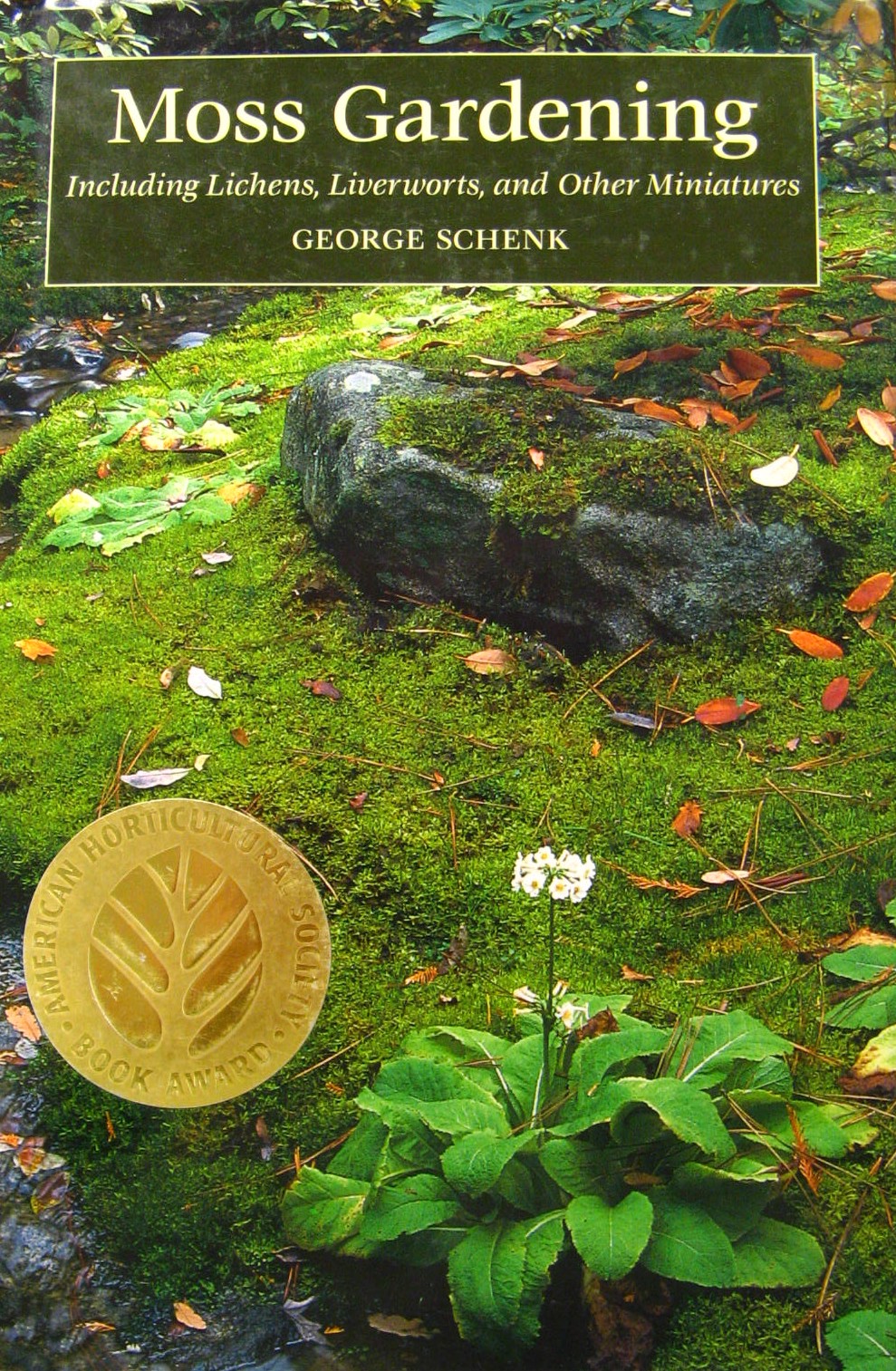
Moss Gardening Book

This is the book to have if you are interested in using moss in your garden. There is not another book quite like it or any alternatives. Overall I really like this book. There are great photographs throughout the book. It begins by introducing you to mosses in a biological manner and points out what things are and aren't moss. That is where I usually start when giving a presentation about moss and I think that it is a good approach. He transitions into the history of moss gardening both in Japan and in Western countries. Good locations for growing moss are discusses as well as propagation techniques. My favorite chapter is Chapter 14, entitled Portraits. This chapter introduces the reader to 70 different species of moss, lichen, and liverwort. There are brief descriptions of the species and the habitats in which they grow. Fun facts and antidotes about some of the species are also included.

The main thing that this book is missing is a section on conservation. Encouraging people to garden with moss is great! But it is also important to encourage people to be good stewards of the moss that grows wild on their property or in surrounding areas. Removal of small pieces of mosses (think the size of a quarter or dime) from an area will most likely not damage the moss community. However large patches of mosses should not be removed from any surface, either tree bark, stone, decaying wood or soil. Basically large patch removal (saucer to dinner plate size) is the equivalent of strip mining in the moss world. If more moss than a small patch is needed to transplant or make a moss slurry (see pg 158 in the book), I would recommend collecting patches from several different places across a larger area. That way there is moss close to the open patches that can grow to fill the space. I think that conservation and stewardship are important topics to think about in the context of gardening with moss. I hope that everyone who gardens with moss or enjoys them in the out of doors will also think of what they can do to protect and care for these great little plants.

Moss Gardening: Including Lichens, Liverworts and Other Miniatures By George Schenk

Learning mosses at SOBEFREE

At the end of March I attended the SOBEFREE foray with amateur and professional bryologists from across California and beyond. I highly recommend attending this foray, especially if you live in California. This year we went to some really great locations in Santa Cruz county and I learned tons of California mosses. The days are spent hiking and collecting mosses with our permits in hand. Then the evenings we all gather around our microscopes to look at the plants and to identify them to species.

With my new skills in hand, I decided to take a look at some of my older photos to see if I could make any identifications. I looked at my desktop calendar from January and now recognize the species. It is Dendroalsia abietina! It is a super common moss on trees in California. When dry the leaves curl downward and may remind you of a clenched fist. When wet, the fronds are splayed out and form an array of small shelves across the trunk. Peek beneath the fronds to find the short sporophytes hiding on the undersides in clusters. I love learning the names of new plants, especially mosses. I often think of it as making new botanical friends.


Being out in the field and looking at plants was such a great change of pace from being in the laboratory. I am hoping that I can make it to the Schofield Bryophyte and Lichen foray up in British Columbia this fall. I don't think the time and location have been announced yet. As soon as I hear I will share it here on the blog.

It would also be nice to stop by the University of British Columbia while up in Canada to meet the chemists I am collaborating with. I have only interacted with them through email and skype. It would be great to see them and their lab setup in person. 

Keep your eyes peeled for the announcement about SOBEFREE 2015, which will be held in March somewhere in California. I will most certainly be there next year! 

September 2015 Desktop Calendar

Some Grimmiaceae mosses hanging out with an intensely yellow lichen pal 
from the 2015 SO BE FREE moss foray in the San Bernardino Mountains of California.


1 - Single click on the image to open it up in a new window. (If you use the image directly from the blog post you will lose a lot of resolution.)

2 - Right-click (or ctrl-click) on the image, and chose the option that says, "Set as Desktop Background" or "Use Image as Desktop Picture" or "Save Image As...". The wording may vary. (If saving the image to your computer is the only option, then locate it on your computer and choose the "Set as Desktop Background" or "Use Image as Desktop Picture" option from there.)

3 - If the image does not fit your desktop neatly, you may have to adjust the image (Mac: System Preferences - Desktop and Screen Saver - Desktop; Windows: Control Panel - Display - Desktop) and choose "Fill screen" as the display mode of your background image.

Corticolous Mosses at Bioblitz 2009

The Bioblitz a couple of weeks ago went well. I think that we counted about 40 bryophyte species and 40 lichen species in the survey area. We were in both Keney Park in Hartford, CT and in a floodplain area of the Connecticut River. I got some good shots of some pretty cool corticolous mosses. A moss that is corticolous grows on tree bark. Many of them had sporophytes peeking out from amongst the green, as you can see from the photos below.


In the floodplain area that we visited there were tons, I mean tons, of mosquitoes and poison ivy. I have encountered worse mosquitoes before. When I went on a field course to the Bahamas as an undergraduate I was eaten alive by mosquitoes over the two week course. I counted and had hundreds of bites on one leg. However the poison ivy on this Bioblitz excursion was more than I have ever seen before. Knee and hip high patches galore. Vines climbing almost every tree. I often went to bush a branch out of my way only to realize that it was not coming from the tree but from the poison ivy attached to it.

Here is a photo of me hiding from the mosquitoes in my rain jacket. Can you spot all the poison ivy in the background?


The poison ivy is above my head and to the right.

Thanks to Dr. Emmanuël Sérusiaux for taking this photo.

2008 Connecticut Bioblitz

Mark your calendars, this year's Bioblitz is quickly approaching! It will be held May 30 & 31 in Stratford, Connecticut and is sponsored by Connecticut’s Beardsley Zoo and the Yale Peabody Museum of Natural History.

A bioblitz is a 24 hour survey of the biological diversity of a designated area, such as a park or an entire town. Researchers who study all types of plants and animals, assisted by school children and the general public, hunt for as many species as they can find and identify. Thus taking a biological inventory of the biological diversity in an area. There are also events, activities and presentations given by the researchers. Yes this is a 24 hour event and quite a few people stay up all night, but sleeping is permitted. Usually the general public is just there during daylight hours, but trapping of insects and other nocturnal creatures does happen throughout the night which the general public can participate in. (We just collect the mosses during the daytime and then identify them through the night.)

I have attended two previous Bioblitz events (sponsored by the Center for Conservation and Biodiversity and Connecticut State Museum of Natural History) as part of the Bryophyte and Lichen group. Last year we identified 95 species form the Middletown area of Connecticut.

A bioblitz is a really great event! I would highly recommend attending a local bioblitz to anyone who is interested in biology and learning new species. It is also a great chance to interact with expert scientists who work in Connecticut or your local area.


Spring Cleaning

I did a little spring cleaning this week in preparation for a party at my apartment tonight. During the cleaning I ran across this shampoo and conditioner. Oh yes, you can have mosses added to your personal hair-care products. Look there, it says moss right on the bottle. I can't recall if I ever actually used this shampoo/conditioner. I think that I bought it on a lark. Either way it appears to have been discontinued by Aveda.


It lists Iceland Moss extract (Cetraria islandica) as one of the ingredients. But wait, when I looked up this species to find out more information I was in for a shock!

It is not a moss at all, but a lichen that goes by the name of Iceland Moss. Another bryophyte want-to-be. Not only has it been used in hair products, but is edible and has been used in folk medicines. Just goes to show that when it says it is a moss that does not necessarily mean that it is a bryophyte.

How many Moss Species are there in Ohio?

After seeing the county by county breakdown for moss species on the Ohio Moss and Lichen Association website, I was thinking about the total number of moss species for the state. How many are there in the state of Ohio?

Fortunately post #19 of the Introduction to Moss Identification covers just this topic. There are a couple of different publications that have assessed the moss flora of Ohio that are mentioned in the post. They list 385 species and 15 varieties of mosses for Ohio. That is a decent number of mosses, considering that there are approximately 1,200 species in North America

You might be thinking, what is the difference between a species and a variety? Well a variety is one of the official categories below the level of species that is recognized by the International Code of Botanical Nomenclature. Yes there are a whole set of rules governing the official naming of plants. (Animals have their own separate set of rules.) However the definition of variety is a pretty vague and might vary depending on who you ask. It could be defined as a local or ecological race or a group or population that has a morphological distinguishing feature that stands out from the rest of the species. Basically it is a category that is up to the discretion of the researcher if they want to use it. Some researchers would just avoid using this category all together and would rather species be the smallest grouping that is used.

Personally I have both proposed that a previously recognized variety be elevated to the species level and that a previously recognized species be recognized only as a subspecies/variety. (For more details on this study check out the reference below.) I think that it depends upon the situation, but I am not opposed to categories below the level of species, as long as they do not get out of hand. Too many varieties per species can make the naming and keeping track of them pretty messy.

Budke, Jessica M., and Bernard Goffinet. 2006. Phylogenetic analysis of Timmiaceae (Bryophyta: Musci) based on nuclear and chloroplast sequence data. Systematic Botany 31(4): 633-641.