Field of Science
-
-
Change of address1 year ago in Variety of Life
-
Change of address1 year ago in Catalogue of Organisms
-
-
Earth Day: Pogo and our responsibility1 year ago in Doc Madhattan


Hypothes.is on Kickstarter - Taking Peer Review to the Internet

I heard about this project over at Uncommon Ground. I think that sounds like a pretty interesting idea for evaluating information that is posted on the web. Check it out and see what you think.
Poop - Where Bryologists and Ornithologists Overlap
We read a paper last week in lab group about goose poop. Yes this is still a blog about about bryophytes and I am going to write about poop today.
In this paper, the goal was to optimize a methodology for extracting bryophyte DNA from the poop/faeces of the barnacle goose. Then they use the DNA to identify the different bryophyte species that the birds had eaten. It is pretty amazing that they were able to identify the mosses from the goose poop using DNA. I think that this sounds much better than digging through the poop trying to identify the bryohytes from small pieces of leaves.
I ran into a bunch of the ornithologists (the folks who study birds) who work in my department and we had a fun discussion about all the possibilities for studying bird poop and the plant contents of the poop.
It made me think about the Science Communication seminar that I have taken and the book Don't be Such a Scientist that we read a couple of years back. One of the ideas in the book is that that there are several ways to appeal to an audience when communicating science. Intellect - Feeling - Humor - Sex. I think that bodily functions, including poop, could be added in too. Poop is definitely a topic for communicating science that appeals to everyone. Ok maybe appeals is the wrong word. But it is definitely a process everyone can relate to, whereas studying mosses can at times be a little esoteric.
I thought that it was a really fun paper and good science too!
Hot off the Geothermal Presses
I read this study in the latest issue of the International Journal of Plant Sciences. I thought that it was a really neat study and is an easily accessible piece of scientific literature for folks to read who are not professional bryologists.
The premise - In stressful environments, studies suggest that sexual reproduction is favored. Researchers examine this idea in mosses across a geothermal gradient in Lassen Volcanic National Park in California.
Methodology - They collected data on sporophyte and gametoecia production from species in the field. (Yeah, gametoecia. I had to look this word up. It is both the gametangia and the surrounding leaves together.) They also collected data on temperature. The collection locations were divided up into geothermal and nongeothermal sites based on the temperature measures.
Also they ran a common garden experiment with Pohlia nutans to look at whether a genetic adaptation was limiting sporophyte production or if alternatively the extreme stress was the cause of low sporophyte production.
Results - Their results indicate that there were lower rates of sporophyte production, due to lower rates of gametoecia formation at the geothermal sites. These rates for both sporophyte and gametoecia production were higher at the nongeothermal sites. When plants from both types of sites were grown in greenhouse conditions these relationships disappear.
Implications - This study does not support the idea that sexual reproduction is favored in stressful environments. It actually shows the complete opposite for this species of mosses. Sexual reproduction decreases with increased temperature stress. The authors state that the "regression between temperature and sporophyte production was not high." And go on to suggest that other stresses such as heavy metals may be involved. They discuss that other studies in fungi and mosses have shown similar patterns and cite several studies.
I was wondering whether they thought that differences in light or perhaps levels of desiccation could be an influence too.
Postcards
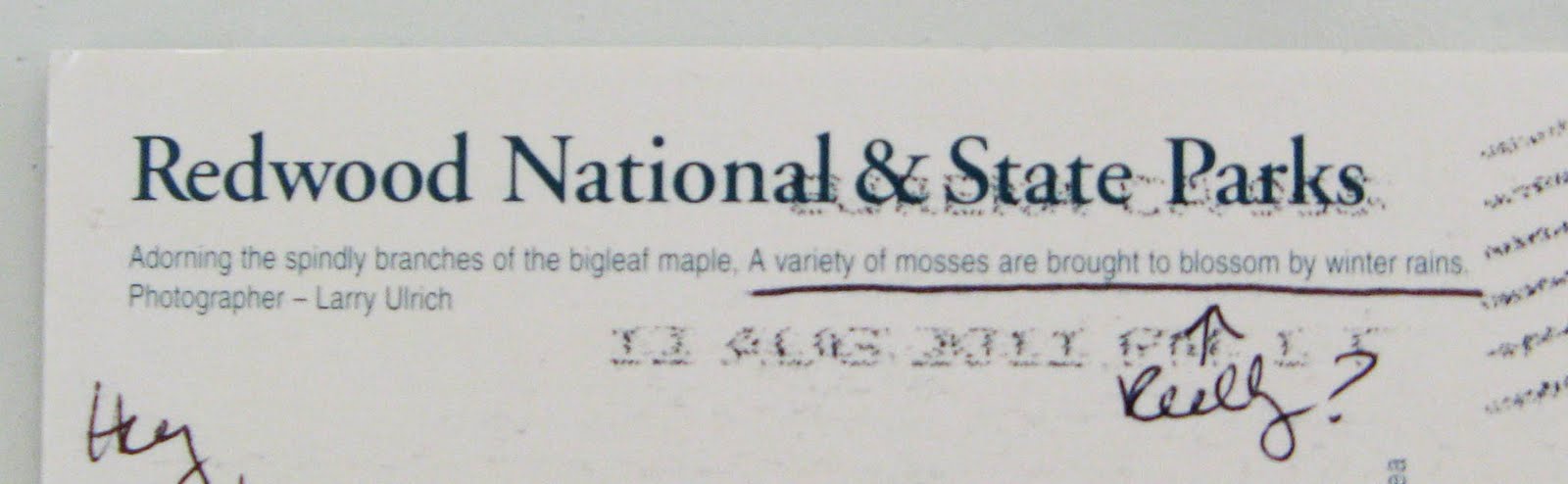
 One of the postcards that I got this summer prominently featured mosses from northern California. A picture of the postcard is on the right. I also took a photo of the caption on the back. Check out the portion that my friend underlined. It reads "A variety of mosses are brought to blossom by winter rains." What strikes you about this sentence? How about the word blossom? Blossoming refers to flowers, and mosses don't have flowers! This is a common terminology mistake. People are much more familiar with flowering plants and when looking at mosses they typically try to use flowering plant terms. Mosses with sporophytes are often said to be fruiting or blooming. Figuring out what word to use can be a challenge. Sporulating? Sporophyting? Usually what I say is that they are reproducing and releasing spores. Most people are familiar with reproduction and then I can go on to explain more about spores if needed.
 This might seem like I am just being picky, but using the correct word is important for making comparisons between mosses and other plants. The little sporophytes that the mosses are producing are not the same as flowers, but are actually equivalent to an entire redwood tree! I think that comparison has much more wow factor that just being a gaudy flower.


Relationships between the Three Groups of Bryophytes
I got an email this week from a colleague about the state of the relationships among the three groups of bryophytes: Mosses, Liverworts, and Hornworts.
The first questions to consider - Are they three separate lineages? OR One monophyletic lineage?
If they are three separate lineages, what order should they be placed in relative to tracheophytes (plants that have tracheids, a special type of xylem)?
Well it all depends on which data are used.
 Data from sperm ultrastructure (Garbary et al. 1993) and DNA data from entire chloroplast genomes (Nishiyama et al. 2003) points to the three groups being part of a monophyletic lineage, as in the diagram on the right.
However all the other studies that I can think of support these three lineages as independent and as a grade diverging prior to the evolution of the tracheophytes.

This phylogenetic relationship was proposed based on morphology, physiology, and biochemistry data (Mishler & Churchill 1984). Then subsequently supported by molecular sequence data (Mishler et al. 1994).

Another alternative hypothesis was supported by sporophyte morphological data (Garbary & Renzaglia 1998) and cox3 mitochondrial sequence data (Malek et al. 1996).
So, I think that this could be presented to students as an active scientific example of different data giving conflicting signals. Often science is much messier than we explain to students. They could be presented with multiple alternative hypotheses for these relationships and have to discuss the different scenarios or perhaps the different types of data used for each.
However, if I only wanted to present one phylogenetic relationship to my students I would go with this one, below. This relationship is supported by Qui et al. (2006), which uses molecular sequence data from the chloroplast, mitochondria and nucleus on over 100 taxa. Others may disagree, but this is the phylogeny that I would recommend using as our most current hypothesis for teaching students about relationships among the bryophytes.

References
Garbary, D. J., K. S. Renzaglia & J. G. Duckett. 1993. The phylogeny of land plants: A cladistic analysis based on male gametogenesis. Plant Systematics and Evolution 188: 237-269.
Garbary, D. J. & K. S. Renzaglia. 1998. Bryophyte phylogeny and the evolution of land plants: Evidence from development and ultrastructure. Pp. 45-63 in J. W. Bates, N. W. Ashton & J. G. Duckett (Editors), Bryology for the Twenty-first Century. Maney Publishing, Leeds.
Kenrick, P. & P. R. Crane. 1997. The Origin and Early Diversification of Land Plants. Smithsonian Institution Press, Washington, D.C.
Malek, O., K. Lättig, R. Hiesel, A. Brennicke & V. Knoop. 1996. RNA editing in bryophytes and a molecular phylogeny of land plants. The European Molecular Biology Organization Journal 15: 1403-1411.
Mishler, B. D. & S. P. Churchill. 1984. A cladistic approach to the phylogeny of "bryophytes." Brittonia 36:406-424.
Mishler, B. D., L. A. Lewis, M. A. Buchheim, K. S. Renzaglia, D. L. Garbary, C. F. Delwiche, F. W. Zechman, T. S. Kantz & R. L. Chapman. 1994. Phylogenetic relationships of the “green algae” and “bryophytes”. Annals of the Missouri Botanical Garden 81: 451-483.
Nishiyama, T., P. G. Wolf, M. Kughita, R. B. Sinclair, M. Sugita, C. Sugiura, T. Wakasugi, K. Yamada, K. Yoshinaga, K. Yamaguchi, K. Euda & M. Hasebe. 2004. Chloroplast phylogeny indicates that bryophytes are monophyletic. Molecular Biology and Evolution 21: 1813-1819.
What kind of Scientist are You?
I spent the past couple of weeks helping a friend move across the country. While on our travels I read this post from one of the professors in my department at the University of Connecticut. The idea is that you can identify what type of scientist you are in a personality-test fashion, based on whether you are Theory- or Data-Driven and a Nerd or Adventurer.
The four types of scientists are listed below and are defined here by Virginia Hughes.
The Data-Driven Nerd
The Theory-Driven Nerd
The Data-Driven Adventurer
The Theory-Driven Adventurer
 This stimulated some fun discussions while passing the time on the drive. I am definitely a Data-Driven Nerd. The part of science that I enjoy the most is running experiments in the lab. Though I do like adventure I usually get my fix through vacation travel on my time off, not directly through my research. And writing up my experiments for publication is my least favorite part of the process. My friend on the other hand is a Theory-Driven Adventurer. She is a political geographer who does her research in southeast Asia. I went to visit her last year while she was in Malaysia. A vacation adventure for me.
 I thought that this was a fun way to think about ourselves as scientists and what drives our interest in the questions that we ask. And I wanted to spread the word.
What kind of scientist are you?
Another Moss Misnomer

I am always on the lookout for plants called mosses that are actually not. I visited the Missouri Botanical Garden with some friends while in St. Louis a few weeks back for the Botany 2011 conference. There I spotted this plant labeled Moss Fern. It is Selaginella pallescens, which is a lycopod or more traditionally called a fern ally. It is distantly related to moss as they are both green plants, but is definitely not a true moss. It has both vasculature (internal plumbing of xylem and phloem) as well as true roots to anchor it into the soil and function in water uptake.
There is a lot of plant life going on in this photo. The Selaginella is located behind the sign-post and also directly to the left. A few other species made it into the shot including a palm in the upper left and some mosses in the lower left.
There were quite a few other spots around the garden where mosses were growing, however, none of them were labeled. It is a bit of a bummer that the mosses are so blatantly ignored at a botanical garden. Here are a few shots from mosses inside the Climatron.


In general the garden didn't seem to add any fake animals to add to the tropical ambiance, thus this frog below looked a little out of place.

Some additional photos of the garden plants and me constantly looking for mosses can be seen over at my friend Em's blog.
A New TV show about Plants from the BSA conference
The blog is changing
You may have noticed some changes to the look of the blog recently. It is in the process of being migrated to the science blog network Field of Science. I decided that it might be a fun step in the evolution of my blog to join up with other scientists for more interactive discussions about science and mosses.
I am off to the Botanical Society of America's annual conference on Saturday to present a part of my dissertation research on the calyptra cuticle in the moss Funaria hygrometrica. Also I will be presenting results from a group project in my lab on the systematics and morphological evolution in the Funariaceae.
Wish me luck it is my first time presenting TWO talks at a scientific meeting and they are on the same day!
Posts Three Days in a Row!
On top of posting our teaching and outreach resources online, I also updated my personal website. I added in a page about teaching and a gallery with photos of both my labmates and mosses. Also I had a few new and future publications to add to that page. I am in the process of gearing up for my phd defense in October and hitting the job market soon after. I figured that my website could use an update. Blog posting may be a little light until post-defense time.
A Visit to the Miniature Forest - Brochure

Insights into the biology and evolution of Bryophytes in Northeastern Connecticut
The naturalist walking through the forests and wetlands of Northeastern Connecticut searches for the hidden flowers and listens to the songs of the birds. The mosses and liverworts that cover the trail bank, color the tree trunks in shades of green and form soft cushions or carpets on the boulders, typically pass unnoticed. Yet several hundred species of Bryophytes occur in our region, and provide important services to the ecosystem, including partially controlling water movement, decreasing erosion, and providing microhabitats for numerous invertebrates. They can even dominate the vegetation in an area or, as in rainforests, compose a majority of the biomass in a local area.
Bryophytes are common, diverse and locally abundant. A closer look at their architecture, habitat, and life history provides insights into the ecological roles of bryophytes, the challenges encountered by plants on land and the solutions to some of these obstacles. This guide is not a field guide to the bryophytes of the forest. Accurate identification of bryophyte species often requires observation of microscopic characters. The guide aims to highlight some of the species common to the area and to raise awareness of bryophytes as a component of our forests, presenting aspects of plant biology through the “eyes” of a bryophyte.
(Click here to link to my website where you can download a free color PDF version of this brochure.)
Please contact Dr. Bernard Goffinet (bernard.goffinet@uconn.edu) to order printed color versions of this brochure. Printing fees of approximately $3.50 per brochure may apply.
Credits: These resources were developed by Jon Swanson, M.S. (Edwin O. Smith High School, Storrs, CT), Jessica Budke, M.S., and Bernard Goffinet Ph.D. (Department of Ecology and Evolutionary Biology, University of Connecticut, Storrs, CT) funded by a grant from the National Science Foundation (DEB-0919284).
Chemical Competition in Peatland Plants using the Moss Sphagnum
Laboratory Resources for High School Biology Teachers

These laboratory exercises were designed to help students to better understand the concept of chemical competition in ecology using the moss Sphagnum. These exercises aim to show students that not all competition is carried out by animals and not all competition is a physical battle, as most of the traditional examples show. By using the chemical alteration of the environment by Sphagnum, students can also be taught about pH, in a biological framework. As a result, the labs can be used in either an ecology unit or a chemistry unit, within a biology course.
Powerpoint Introduction – Includes 15 slides that introduce the concepts of competition, ion exchange in Sphagnum mosses and succession in peatlands.
Laboratory Exercise 1 – The ability to alter the pH of the water surrounding it is compared between Sphagnum moss and another non-moss aquatic plant.
Laboratory Exercise 2 – The ability of Sphagnum to alter the pH of the water surrounding it is compared with and without additional ions.
Teacher’s Notes – Pre-laboratory preparation, data collection, and Sphagnum collection are covered.
Credits: These resources were developed by Jon Swanson, M.S. (Edwin O. Smith High School, Storrs, CT), Jessica Budke, M.S., and Bernard Goffinet Ph.D. (Department of Ecology and Evolutionary Biology, University of Connecticut, Storrs, CT) funded by a grant from the National Science Foundation (DEB-0919284).
Subscribe to:
Posts (Atom)