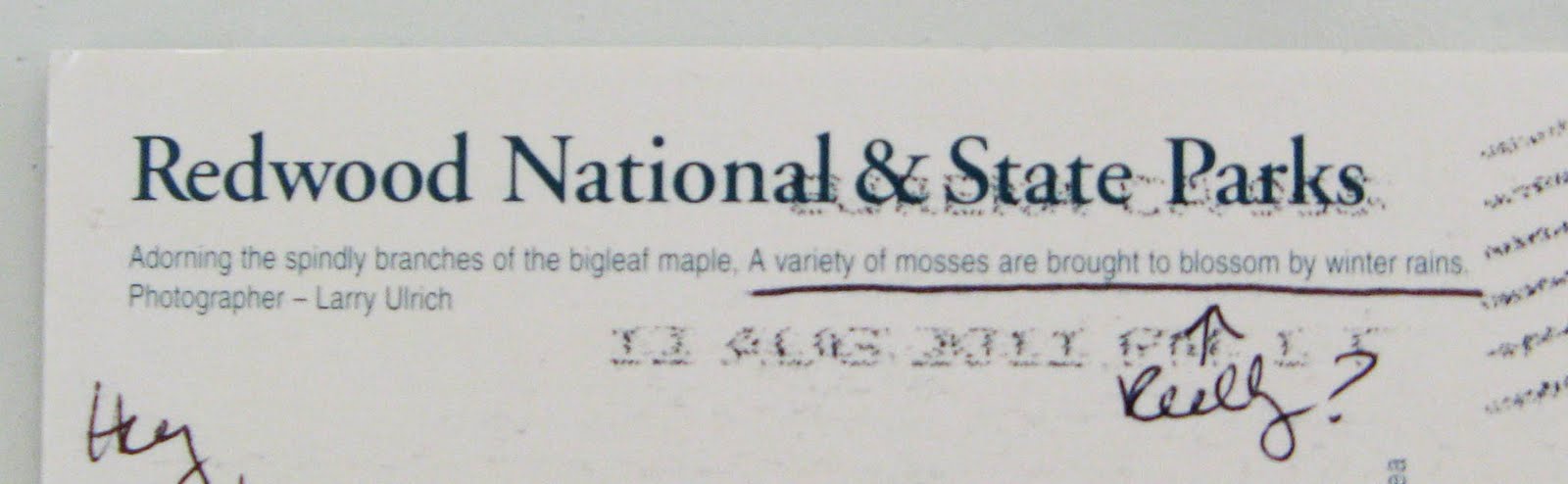
This might seem like I am just being picky, but using the correct word is important for making comparisons between mosses and other plants. The little sporophytes that the mosses are producing are not the same as flowers, but are actually equivalent to an entire redwood tree! I think that comparison has much more wow factor that just being a gaudy flower.
- Home
- Angry by Choice
- Catalogue of Organisms
- Chinleana
- Doc Madhattan
- Games with Words
- Genomics, Medicine, and Pseudoscience
- History of Geology
- Moss Plants and More
- Pleiotropy
- Plektix
- RRResearch
- Skeptic Wonder
- The Culture of Chemistry
- The Curious Wavefunction
- The Phytophactor
- The View from a Microbiologist
- Variety of Life
Field of Science
-
-
Change of address1 year ago in Variety of Life
-
Change of address1 year ago in Catalogue of Organisms
-
-
Earth Day: Pogo and our responsibility1 year ago in Doc Madhattan
-
What I Read 20241 year ago in Angry by Choice
-
I've moved to Substack. Come join me there.1 year ago in Genomics, Medicine, and Pseudoscience
-
-
-
-
Histological Evidence of Trauma in Dicynodont Tusks7 years ago in Chinleana
-
Posted: July 21, 2018 at 03:03PM8 years ago in Field Notes
-
Why doesn't all the GTA get taken up?8 years ago in RRResearch
-
-
Harnessing innate immunity to cure HIV10 years ago in Rule of 6ix
-
-
-
-
-
-
post doc job opportunity on ribosome biochemistry!11 years ago in Protein Evolution and Other Musings
-
Blogging Microbes- Communicating Microbiology to Netizens11 years ago in Memoirs of a Defective Brain
-
Re-Blog: June Was 6th Warmest Globally12 years ago in The View from a Microbiologist
-
-
-
The Lure of the Obscure? Guest Post by Frank Stahl14 years ago in Sex, Genes & Evolution
-
-
Lab Rat Moving House15 years ago in Life of a Lab Rat
-
Goodbye FoS, thanks for all the laughs15 years ago in Disease Prone
-
-
Slideshow of NASA's Stardust-NExT Mission Comet Tempel 1 Flyby15 years ago in The Large Picture Blog
-
in The Biology Files
Postcards
Relationships between the Three Groups of Bryophytes
I got an email this week from a colleague about the state of the relationships among the three groups of bryophytes: Mosses, Liverworts, and Hornworts.
The first questions to consider - Are they three separate lineages? OR One monophyletic lineage?
If they are three separate lineages, what order should they be placed in relative to tracheophytes (plants that have tracheids, a special type of xylem)?
Well it all depends on which data are used.
Data from sperm ultrastructure (Garbary et al. 1993) and DNA data from entire chloroplast genomes (Nishiyama et al. 2003) points to the three groups being part of a monophyletic lineage, as in the diagram on the right.However all the other studies that I can think of support these three lineages as independent and as a grade diverging prior to the evolution of the tracheophytes.
This phylogenetic relationship was proposed based on morphology, physiology, and biochemistry data (Mishler & Churchill 1984). Then subsequently supported by molecular sequence data (Mishler et al. 1994).
Another alternative hypothesis was supported by sporophyte morphological data (Garbary & Renzaglia 1998) and cox3 mitochondrial sequence data (Malek et al. 1996).
So, I think that this could be presented to students as an active scientific example of different data giving conflicting signals. Often science is much messier than we explain to students. They could be presented with multiple alternative hypotheses for these relationships and have to discuss the different scenarios or perhaps the different types of data used for each.
However, if I only wanted to present one phylogenetic relationship to my students I would go with this one, below. This relationship is supported by Qui et al. (2006), which uses molecular sequence data from the chloroplast, mitochondria and nucleus on over 100 taxa. Others may disagree, but this is the phylogeny that I would recommend using as our most current hypothesis for teaching students about relationships among the bryophytes.
References
Garbary, D. J., K. S. Renzaglia & J. G. Duckett. 1993. The phylogeny of land plants: A cladistic analysis based on male gametogenesis. Plant Systematics and Evolution 188: 237-269.
Garbary, D. J. & K. S. Renzaglia. 1998. Bryophyte phylogeny and the evolution of land plants: Evidence from development and ultrastructure. Pp. 45-63 in J. W. Bates, N. W. Ashton & J. G. Duckett (Editors), Bryology for the Twenty-first Century. Maney Publishing, Leeds.
Kenrick, P. & P. R. Crane. 1997. The Origin and Early Diversification of Land Plants. Smithsonian Institution Press, Washington, D.C.
Malek, O., K. Lättig, R. Hiesel, A. Brennicke & V. Knoop. 1996. RNA editing in bryophytes and a molecular phylogeny of land plants. The European Molecular Biology Organization Journal 15: 1403-1411.
Mishler, B. D. & S. P. Churchill. 1984. A cladistic approach to the phylogeny of "bryophytes." Brittonia 36:406-424.
Mishler, B. D., L. A. Lewis, M. A. Buchheim, K. S. Renzaglia, D. L. Garbary, C. F. Delwiche, F. W. Zechman, T. S. Kantz & R. L. Chapman. 1994. Phylogenetic relationships of the “green algae” and “bryophytes”. Annals of the Missouri Botanical Garden 81: 451-483.
Nishiyama, T., P. G. Wolf, M. Kughita, R. B. Sinclair, M. Sugita, C. Sugiura, T. Wakasugi, K. Yamada, K. Yoshinaga, K. Yamaguchi, K. Euda & M. Hasebe. 2004. Chloroplast phylogeny indicates that bryophytes are monophyletic. Molecular Biology and Evolution 21: 1813-1819.
What kind of Scientist are You?
I spent the past couple of weeks helping a friend move across the country. While on our travels I read this post from one of the professors in my department at the University of Connecticut. The idea is that you can identify what type of scientist you are in a personality-test fashion, based on whether you are Theory- or Data-Driven and a Nerd or Adventurer.
The four types of scientists are listed below and are defined here by Virginia Hughes.
The Data-Driven Nerd
The Theory-Driven Nerd
The Data-Driven Adventurer
The Theory-Driven Adventurer
I thought that this was a fun way to think about ourselves as scientists and what drives our interest in the questions that we ask. And I wanted to spread the word.
What kind of scientist are you?
Another Moss Misnomer
I am always on the lookout for plants called mosses that are actually not. I visited the Missouri Botanical Garden with some friends while in St. Louis a few weeks back for the Botany 2011 conference. There I spotted this plant labeled Moss Fern. It is Selaginella pallescens, which is a lycopod or more traditionally called a fern ally. It is distantly related to moss as they are both green plants, but is definitely not a true moss. It has both vasculature (internal plumbing of xylem and phloem) as well as true roots to anchor it into the soil and function in water uptake.
There is a lot of plant life going on in this photo. The Selaginella is located behind the sign-post and also directly to the left. A few other species made it into the shot including a palm in the upper left and some mosses in the lower left.
There were quite a few other spots around the garden where mosses were growing, however, none of them were labeled. It is a bit of a bummer that the mosses are so blatantly ignored at a botanical garden. Here are a few shots from mosses inside the Climatron.
In general the garden didn't seem to add any fake animals to add to the tropical ambiance, thus this frog below looked a little out of place.
Some additional photos of the garden plants and me constantly looking for mosses can be seen over at my friend Em's blog.
A New TV show about Plants from the BSA conference
I just got back from the botany meeting out in St. Louis. Presentations were really stimulating and interesting. St. Louis was hot and sticky. Overall a great time was had!
The blog is changing
You may have noticed some changes to the look of the blog recently. It is in the process of being migrated to the science blog network Field of Science. I decided that it might be a fun step in the evolution of my blog to join up with other scientists for more interactive discussions about science and mosses.
I am off to the Botanical Society of America's annual conference on Saturday to present a part of my dissertation research on the calyptra cuticle in the moss Funaria hygrometrica. Also I will be presenting results from a group project in my lab on the systematics and morphological evolution in the Funariaceae.
Wish me luck it is my first time presenting TWO talks at a scientific meeting and they are on the same day!
Posts Three Days in a Row!
On top of posting our teaching and outreach resources online, I also updated my personal website. I added in a page about teaching and a gallery with photos of both my labmates and mosses. Also I had a few new and future publications to add to that page. I am in the process of gearing up for my phd defense in October and hitting the job market soon after. I figured that my website could use an update. Blog posting may be a little light until post-defense time.
A Visit to the Miniature Forest - Brochure
Insights into the biology and evolution of Bryophytes in Northeastern Connecticut
The naturalist walking through the forests and wetlands of Northeastern Connecticut searches for the hidden flowers and listens to the songs of the birds. The mosses and liverworts that cover the trail bank, color the tree trunks in shades of green and form soft cushions or carpets on the boulders, typically pass unnoticed. Yet several hundred species of Bryophytes occur in our region, and provide important services to the ecosystem, including partially controlling water movement, decreasing erosion, and providing microhabitats for numerous invertebrates. They can even dominate the vegetation in an area or, as in rainforests, compose a majority of the biomass in a local area.
Bryophytes are common, diverse and locally abundant. A closer look at their architecture, habitat, and life history provides insights into the ecological roles of bryophytes, the challenges encountered by plants on land and the solutions to some of these obstacles. This guide is not a field guide to the bryophytes of the forest. Accurate identification of bryophyte species often requires observation of microscopic characters. The guide aims to highlight some of the species common to the area and to raise awareness of bryophytes as a component of our forests, presenting aspects of plant biology through the “eyes” of a bryophyte.
(Click here to link to my website where you can download a free color PDF version of this brochure.)
Please contact Dr. Bernard Goffinet (bernard.goffinet@uconn.edu) to order printed color versions of this brochure. Printing fees of approximately $3.50 per brochure may apply.
Credits: These resources were developed by Jon Swanson, M.S. (Edwin O. Smith High School, Storrs, CT), Jessica Budke, M.S., and Bernard Goffinet Ph.D. (Department of Ecology and Evolutionary Biology, University of Connecticut, Storrs, CT) funded by a grant from the National Science Foundation (DEB-0919284).
Chemical Competition in Peatland Plants using the Moss Sphagnum
Laboratory Resources for High School Biology Teachers
These laboratory exercises were designed to help students to better understand the concept of chemical competition in ecology using the moss Sphagnum. These exercises aim to show students that not all competition is carried out by animals and not all competition is a physical battle, as most of the traditional examples show. By using the chemical alteration of the environment by Sphagnum, students can also be taught about pH, in a biological framework. As a result, the labs can be used in either an ecology unit or a chemistry unit, within a biology course.
Powerpoint Introduction – Includes 15 slides that introduce the concepts of competition, ion exchange in Sphagnum mosses and succession in peatlands.
Laboratory Exercise 1 – The ability to alter the pH of the water surrounding it is compared between Sphagnum moss and another non-moss aquatic plant.
Laboratory Exercise 2 – The ability of Sphagnum to alter the pH of the water surrounding it is compared with and without additional ions.
Teacher’s Notes – Pre-laboratory preparation, data collection, and Sphagnum collection are covered.
Credits: These resources were developed by Jon Swanson, M.S. (Edwin O. Smith High School, Storrs, CT), Jessica Budke, M.S., and Bernard Goffinet Ph.D. (Department of Ecology and Evolutionary Biology, University of Connecticut, Storrs, CT) funded by a grant from the National Science Foundation (DEB-0919284).
Mosses at the Aspetuck Land Trust
Here are some photos from the Moss Workshop that I led at the Aspetuck Land Trust at Trout Brook Valley, CT in May. It was a fun group and we got to see quite a few great plants.
Thanks to Heather Williams for helping to organize the workshop. Also thanks to the gal who took and sent me these photos. I can't recall her name at the moment.
Passing out hand lenses and ID sheets before the walk.
Scraping a moss off a rock. Probably an Orthotirchaceae. And now let me tell you about it.
(At least my mouth wasn't gaping open mid-sentence.)
Using a hand lens.
Endangered Species Day
I just read over at Uncommon Ground that today is Endangered Species Day. In the spirit of the day I thought that I would share some information on endangered bryophytes.
In 2008, 95 bryophyte species (including mosses, hornworts and liverworts) were assessed to determine their threat level, habitat, and distribution. (The full report from the IUCN (International Union for Conservation of Nature) can be found here.)
I am definitely going to do a cover-to-cover read of this report before my next moss walk. (Not that I have any scheduled at the moment.) I think that it will really help me to organize and clarify my reasoning and arguments for the importance of bryophytes.
Happy Endangered Species Day!
Keeping up to Speed on the Bryology Literature
There is a phenomenal level of information and science production in the world today. Keeping up to speed on the latest research can be challenging. I have a list of keywords that I use to search through a couple different biological science search engines that the University of Connecticut subscribe (Web of Science and BIOSIS Previews). I try to run this search at least every other month.
Near the end of each volume of The Bryologist is a section entitled Recent literature on bryophytes. This is a great resource for keeping up to speed on the bryology literature. Listed in alphabetical order are a large number of bryology focused papers. I am not sure how the authors assemble this list. I would guess they do some searching using keywords through google scholar and have a list of bryology focused journals that they pull articles from. They also include articles published in languages other than english, but mention if there is an english abstract. If you missed the annual Botanical Society of America conference they include the bryology related abstracts in the list. I think that this is nice because it reminds me about the newest research that folks are working on in their laboratories. These presentations are often about research that is still a year or more away from publication. Doctoral dissertations and Master's degree theses are listed too. These publications can be pretty hard to locate, so it is quite nice that they are included. If the title does not have an obvious bryology connection or the species studied is not listed there is a brief note after the citation with this information.
Next time you are looking for the most recent bryology literature I would highly recommend checking out this list before searching around on your own.
Subscribe to:
Posts (Atom)