Field of Science

Mosses at the Aspetuck Land Trust

Here are some photos from the Moss Workshop that I led at the Aspetuck Land Trust at Trout Brook Valley, CT in May. It was a fun group and we got to see quite a few great plants. 

Thanks to Heather Williams for helping to organize the workshop. Also thanks to the gal who took and sent me these photos. I can't recall her name at the moment. 


Passing out hand lenses and ID sheets before the walk.


 Scraping a moss off a rock. Probably an Orthotirchaceae. And now let me tell you about it. 
(At least my mouth wasn't gaping open mid-sentence.)


 Using a hand lens.

Endangered Species Day

I just read over at Uncommon Ground that today is Endangered Species Day. In the spirit of the day I thought that I would share some information on endangered bryophytes.

In 2008, 95 bryophyte species (including mosses, hornworts and liverworts) were assessed to determine their threat level, habitat, and distribution. (The full report from the IUCN (International Union for Conservation of Nature) can be found here.)

The bryophytes have a detailed report that I was surprised to find on my shelf mashed among my other bryology books. I have linked to the report via googlebooks below. Looking over the report it has some really great information on bryophyte conservation in addition to the species list. They discuss the importance of bryophytes, which is critical for addressing "who cares?" questions that often surround these little plants. The answers that they highlight include: Ecological roles - water retention, peat formation, habitats for other organisms -- Pollution Indicators -- Economic and medicinal uses. Additionally large sections highlight the key habitats of bryophytes and their specific threats. They also examine these threatened species in a regional manner and discuss conservation measures that can be taken relating to bryophytes. 

I am definitely going to do a cover-to-cover read of this report before my next moss walk. (Not that I have any scheduled at the moment.) I think that it will really help me to organize and clarify my reasoning and arguments for the importance of bryophytes.

Happy Endangered Species Day!

Keeping up to Speed on the Bryology Literature

There is a phenomenal level of information and science production in the world today. Keeping up to speed on the latest research can be challenging. I have a list of keywords that I use to search through a couple different biological science search engines that the University of Connecticut subscribe (Web of Science and BIOSIS Previews). I try to run this search at least every other month.

Near the end of each volume of The Bryologist is a section entitled Recent literature on bryophytes. This is a great resource for keeping up to speed on the bryology literature. Listed in alphabetical order are a large number of bryology focused papers. I am not sure how the authors assemble this list. I would guess they do some searching using keywords through google scholar and have a list of bryology focused journals that they pull articles from. They also include articles published in languages other than english, but mention if there is an english abstract. If you missed the annual Botanical Society of America conference they include the bryology related abstracts in the list. I think that this is nice because it reminds me about the newest research that folks are working on in their laboratories. These presentations are often about research that is still a year or more away from publication. Doctoral dissertations and Master's degree theses are listed too. These publications can be pretty hard to locate, so it is quite nice that they are included. If the title does not have an obvious bryology connection or the species studied is not listed there is a brief note after the citation with this information.

Next time you are looking for the most recent bryology literature I would highly recommend checking out this list before searching around on your own.

The Evolution of Spores

The evolution of spores was a critical step in the transition of plants on to land. This paper discusses developmental transitions that may have transferred the formation of the spore wall from the zygote to the spores. I enjoyed reading the paper and thought that it was a really interesting developmental transition.

A Great Season for Mosses in the Pacific Northwest

The New York Times featured an article recently about the plethora of mosses growing in the Seattle area. A rainy winter and spring have produced a great environment for the mosses this year. One of the folks interviewed for the article works at the Bloedel Reserve on Bainbridge Island, near Seattle. They mention that this reserve "claims to have the largest moss garden on the continent". I noted in particular that they categorized this as a claim rather than a statement of fact. Maybe because they don't actually tell you how many acres the moss garden covers? Or no one is keeping a tally of the contest for largest moss garden in North America, so they can't quite be sure? If there was a contest with a reward rather than bragging rights only we might know if there is a larger moss garden out there.

Know of any other large moss gardens in North America? Or abroad?

Spring Cleaning

I did a little spring cleaning this week in preparation for a party at my apartment tonight. During the cleaning I ran across this shampoo and conditioner. Oh yes, you can have mosses added to your personal hair-care products. Look there, it says moss right on the bottle. I can't recall if I ever actually used this shampoo/conditioner. I think that I bought it on a lark. Either way it appears to have been discontinued by Aveda.


It lists Iceland Moss extract (Cetraria islandica) as one of the ingredients. But wait, when I looked up this species to find out more information I was in for a shock!

It is not a moss at all, but a lichen that goes by the name of Iceland Moss. Another bryophyte want-to-be. Not only has it been used in hair products, but is edible and has been used in folk medicines. Just goes to show that when it says it is a moss that does not necessarily mean that it is a bryophyte.

A New Look to the Blog

I thought that the blog was in need of an update. I have had the same style and background since setting it up in 2007. It is a work in progress and I am not sure if I will stick with this update as is or try and tweak it some more. Any comments would be appreciated!

Next up, revising my personal website.

Bryophytes on YouTube

I haven't been on YouTube in quite a long time to look for bryophyte videos. My labmate Juan Carlos recommended this video. A fun highlight is that you get to meet real live bryophytes that talk to the audience (see time 3:42). The costumes that the kids have are great and it is quite exciting to see young folks learning about bryophytes!


I did some more searching on YouTube and came across quite a number of video presentations used to communicate information about bryophytes. Here a couple for your educational-entertainment.


I really liked the part in this one where the water overflows from the antheridium dispersing the sperm to the egg. However I think that the part where thy have the spore production and dispersal is a little confusing. I am not sure exactly which concept they were trying to get across in that part.

Shading by Mosses

Shading of understory plants is caused by the leaves of the taller plants. Mosses have leaves that are typically one cell thick. In this study researchers determined that moss leaves actually block a large percentage the light. The shadowing that results as the leaves wave back and forth results in a flickering pattern of sun flecks that reach the plants beneath.

I think that it is a really cool study and pretty interesting that the mosses, despite having very thin leaves are able to block light creating sun flecks just like larger plants.


Swatland, H. J. 2011.Microphotometry of Underwater Shadowing by a Moss from a Niagara Escarpment Waterfall. Microscopy and Microanalysis 17:125-131.

Mosses Grow on a New Substrate. Whale!

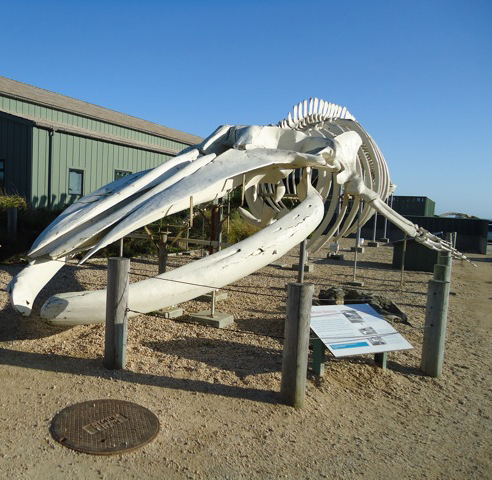
Mosses grow on all sorts of substrates. Soil, tree bark, leaves, rocks, sand, dung, old socks abandoned in the woods, and now a whale! My labmates were out visiting the Seymour Marine Discovery Center at Long Marine Laboratory in Santa Cruz, California over spring break and they brought back these photos of some Funaria hygrometrica (cord mosses) growing on a whale skeleton outside of the center. When they first told me that they found mosses growing on a whale I totally did not believe them, but I was imagining a breathing swimming whale. They even got permission from the Marine Center to collect some of the moss for us to use in our research collection. The description of this collection location on the label is going to be great! Thanks Laura and Juan Carlos for the photos.

You can read more about 'Ms. Blue' the whale here on the Marine Center's website. She has a pretty interesting story that goes from finding a blue whale washed up on the shore to her most recent relocation.


Happy April Fools Day!