


The evolution of spores was a critical step in the transition of plants on to land. This paper discusses developmental transitions that may have transferred the formation of the spore wall from the zygote to the spores. I enjoyed reading the paper and thought that it was a really interesting developmental transition.
Field of Science
-
-
Change of address1 year ago in Variety of Life
-
Change of address1 year ago in Catalogue of Organisms
-
-
Earth Day: Pogo and our responsibility1 year ago in Doc Madhattan
A Great Season for Mosses in the Pacific Northwest

The New York Times featured an article recently about the plethora of mosses growing in the Seattle area. A rainy winter and spring have produced a great environment for the mosses this year. One of the folks interviewed for the article works at the Bloedel Reserve on Bainbridge Island, near Seattle. They mention that this reserve "claims to have the largest moss garden on the continent". I noted in particular that they categorized this as a claim rather than a statement of fact. Maybe because they don't actually tell you how many acres the moss garden covers? Or no one is keeping a tally of the contest for largest moss garden in North America, so they can't quite be sure? If there was a contest with a reward rather than bragging rights only we might know if there is a larger moss garden out there.
Know of any other large moss gardens in North America? Or abroad?
Spring Cleaning
I did a little spring cleaning this week in preparation for a party at my apartment tonight. During the cleaning I ran across this shampoo and conditioner. Oh yes, you can have mosses added to your personal hair-care products. Look there, it says moss right on the bottle. I can't recall if I ever actually used this shampoo/conditioner. I think that I bought it on a lark. Either way it appears to have been discontinued by Aveda.

It lists Iceland Moss extract (Cetraria islandica) as one of the ingredients. But wait, when I looked up this species to find out more information I was in for a shock!
It is not a moss at all, but a lichen that goes by the name of Iceland Moss. Another bryophyte want-to-be. Not only has it been used in hair products, but is edible and has been used in folk medicines. Just goes to show that when it says it is a moss that does not necessarily mean that it is a bryophyte.
A New Look to the Blog
I thought that the blog was in need of an update. I have had the same style and background since setting it up in 2007. It is a work in progress and I am not sure if I will stick with this update as is or try and tweak it some more. Any comments would be appreciated!
Next up, revising my personal website.
Next up, revising my personal website.
The Calyptrae of Funaria hygrometrica have a cuticle.
The first chapter of my PhD dissertation research has been published!
Jessica M. Budke, Bernard Goffinet and Cynthia S. Jones. 2011. A hundred-year-old question: is the moss calyptra covered by a cuticle? A case study of Funaria hygrometrica. Annals of Botany
Below are some links for access to the publication courtesy of Oxford Journals.
Full Text: http://aob.oxfordjournals.org/cgi/content/full/mcr079?ijkey=nTMQI5rz8MP6cGB&keytype=ref
PDF: http://aob.oxfordjournals.org/cgi/reprint/mcr079?ijkey=nTMQI5rz8MP6cGB&keytype=ref
Bryophytes on YouTube
I haven't been on YouTube in quite a long time to look for bryophyte videos. My labmate Juan Carlos recommended this video. A fun highlight is that you get to meet real live bryophytes that talk to the audience (see time 3:42). The costumes that the kids have are great and it is quite exciting to see young folks learning about bryophytes!
I did some more searching on YouTube and came across quite a number of video presentations used to communicate information about bryophytes. Here a couple for your educational-entertainment.
I really liked the part in this one where the water overflows from the antheridium dispersing the sperm to the egg. However I think that the part where thy have the spore production and dispersal is a little confusing. I am not sure exactly which concept they were trying to get across in that part.
I did some more searching on YouTube and came across quite a number of video presentations used to communicate information about bryophytes. Here a couple for your educational-entertainment.
I really liked the part in this one where the water overflows from the antheridium dispersing the sperm to the egg. However I think that the part where thy have the spore production and dispersal is a little confusing. I am not sure exactly which concept they were trying to get across in that part.
Shading by Mosses
Shading of understory plants is caused by the leaves of the taller plants. Mosses have leaves that are typically one cell thick. In this study researchers determined that moss leaves actually block a large percentage the light. The shadowing that results as the leaves wave back and forth results in a flickering pattern of sun flecks that reach the plants beneath.
I think that it is a really cool study and pretty interesting that the mosses, despite having very thin leaves are able to block light creating sun flecks just like larger plants.
Swatland, H. J. 2011.Microphotometry of Underwater Shadowing by a Moss from a Niagara Escarpment Waterfall. Microscopy and Microanalysis 17:125-131.
I think that it is a really cool study and pretty interesting that the mosses, despite having very thin leaves are able to block light creating sun flecks just like larger plants.
Swatland, H. J. 2011.Microphotometry of Underwater Shadowing by a Moss from a Niagara Escarpment Waterfall. Microscopy and Microanalysis 17:125-131.
Conservation of the Western Moss Reserve
I just saw this article on the BBC News about the designation of a peat bog as an United Kingdom Reserve to protect the large heath butterfly. This is great news for this species of butterfly, the mosses and other organisms that call the bog home!
Mosses Grow on a New Substrate. Whale!
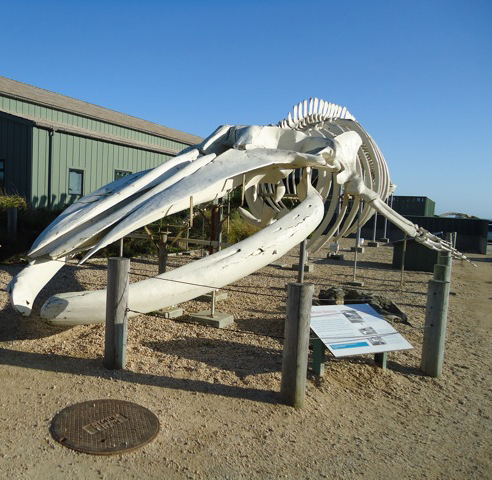
Mosses grow on all sorts of substrates. Soil, tree bark, leaves, rocks, sand, dung, old socks abandoned in the woods, and now a whale! My labmates were out visiting the Seymour Marine Discovery Center at Long Marine Laboratory in Santa Cruz, California over spring break and they brought back these photos of some Funaria hygrometrica (cord mosses) growing on a whale skeleton outside of the center. When they first told me that they found mosses growing on a whale I totally did not believe them, but I was imagining a breathing swimming whale. They even got permission from the Marine Center to collect some of the moss for us to use in our research collection. The description of this collection location on the label is going to be great! Thanks Laura and Juan Carlos for the photos.


Happy April Fools Day!
More Sphagnum research
Directly after the article that I posted about earlier this week was another on Sphagnum by Dr. Eric Karlin and colleagues.
Eric F. Karlin, Sandra B. Boles, Rodney D. Seppelt, Stefano Terracciano, and A. Jonathan Shaw. 2011. The Peat Moss Sphagnum cuspidatum in Australia: Microsatellites Provide a Global Perspective. Systematic Botany 36(1):22-32.
I have yet to read the paper, but here is my non-technical summary of the abstract.
Want to now more about the controversy surrounding the species Sphagnum cuspidatum? Back in the day it was thought to grow on all continents except Antarctica. More recently scientists have proposed that it is limited to Europe and eastern North America. Herein the authors ask the question who is right? Does this species really grow all over the world or does it have a more restricted range? (Cue the dramatic music.) Plants from all over the world were gathered, DNA was removed from their cells and used in some cool science work with microsatelites. The researchers found that Sphagnum cuspidatum grows worldwide in places including Australia, the Philippines, Columbia, and Equatorial Guinea in addition to Europe and eastern North America. And the mystery has been illuminated! Though in science there is always room for more data, and thus reinterpretation of previous results. So this might not be the last word.
I have yet to read the paper, but here is my non-technical summary of the abstract.
Want to now more about the controversy surrounding the species Sphagnum cuspidatum? Back in the day it was thought to grow on all continents except Antarctica. More recently scientists have proposed that it is limited to Europe and eastern North America. Herein the authors ask the question who is right? Does this species really grow all over the world or does it have a more restricted range? (Cue the dramatic music.) Plants from all over the world were gathered, DNA was removed from their cells and used in some cool science work with microsatelites. The researchers found that Sphagnum cuspidatum grows worldwide in places including Australia, the Philippines, Columbia, and Equatorial Guinea in addition to Europe and eastern North America. And the mystery has been illuminated! Though in science there is always room for more data, and thus reinterpretation of previous results. So this might not be the last word.
And the etymology helps the name stick to your brain
A brief bit about one of the journal articles from Systematic Botany that I read this week.
Câmara, Paulo E. A. S. 2011. A Re-Circumscription of the Moss Genus Taxithelium (Pylaisiadelphaceae) with a Taxonomic Revision of Subgenus Vernieri. Systematic Botany 36: 7-21.
It is a taxonomic revision. Meaning that the author looked at all the species within a particular group, by requesting samples from across the world. Then examined them morphologically to determine what the species have in common and how the species are each different. There is typically a key to the species (think a choose your own adventure book that ends at an identification for the plant), illustrations and detailed descriptions. Here, 11 species in the Subgenus Vernieri are examined. The author undertook a large amount of work by examining 6,200 specimens. This type of work can only be described as tedious and time consuming. But I think that this work is essential to establishing good morphologically based species. I am looking forward to seeing the results of his molecular analyses to see if the species hold up. The paper said that they are unpublished, so keep an eye out for the phylogeny in a journal near you.
The fun fact that will help you remember this name of this genus (Taxithelium) is the defining feature of its members. They have multiple papillae on each cell that are arranged in a row. Papillae are little bumps on the outside of the cell that are raised portions of the cell wall. The etymology of the genus name is taxi- taso = arranged and thelion = nipple. Yes you heard it here arranged - nipple. Not a genus name to be easily forgotten. (I wonder if this will result in a whole different set of search hits for the blog? Surprise a page about mosses instead.)
This is another article that I read by this author last year that I really enjoyed.
Câmara, Paulo E. A. S. and Elizabeth A. Kellogg. 2010. Morphology and development of leaf papillae in Sematophyllaceae The Bryologist 113: 22-33.
Câmara, Paulo E. A. S. 2011. A Re-Circumscription of the Moss Genus Taxithelium (Pylaisiadelphaceae) with a Taxonomic Revision of Subgenus Vernieri. Systematic Botany 36: 7-21.
It is a taxonomic revision. Meaning that the author looked at all the species within a particular group, by requesting samples from across the world. Then examined them morphologically to determine what the species have in common and how the species are each different. There is typically a key to the species (think a choose your own adventure book that ends at an identification for the plant), illustrations and detailed descriptions. Here, 11 species in the Subgenus Vernieri are examined. The author undertook a large amount of work by examining 6,200 specimens. This type of work can only be described as tedious and time consuming. But I think that this work is essential to establishing good morphologically based species. I am looking forward to seeing the results of his molecular analyses to see if the species hold up. The paper said that they are unpublished, so keep an eye out for the phylogeny in a journal near you.
The fun fact that will help you remember this name of this genus (Taxithelium) is the defining feature of its members. They have multiple papillae on each cell that are arranged in a row. Papillae are little bumps on the outside of the cell that are raised portions of the cell wall. The etymology of the genus name is taxi- taso = arranged and thelion = nipple. Yes you heard it here arranged - nipple. Not a genus name to be easily forgotten. (I wonder if this will result in a whole different set of search hits for the blog? Surprise a page about mosses instead.)
This is another article that I read by this author last year that I really enjoyed.
Câmara, Paulo E. A. S. and Elizabeth A. Kellogg. 2010. Morphology and development of leaf papillae in Sematophyllaceae The Bryologist 113: 22-33.
Some Blog Publicity
Moss Plants and More has been featured on a website listing the 50 Best Botany Blogs for College Students.
Subscribe to:
Posts (Atom)