Field of Science

Bryophytes on YouTube

I haven't been on YouTube in quite a long time to look for bryophyte videos. My labmate Juan Carlos recommended this video. A fun highlight is that you get to meet real live bryophytes that talk to the audience (see time 3:42). The costumes that the kids have are great and it is quite exciting to see young folks learning about bryophytes!


I did some more searching on YouTube and came across quite a number of video presentations used to communicate information about bryophytes. Here a couple for your educational-entertainment.


I really liked the part in this one where the water overflows from the antheridium dispersing the sperm to the egg. However I think that the part where thy have the spore production and dispersal is a little confusing. I am not sure exactly which concept they were trying to get across in that part.

Shading by Mosses

Shading of understory plants is caused by the leaves of the taller plants. Mosses have leaves that are typically one cell thick. In this study researchers determined that moss leaves actually block a large percentage the light. The shadowing that results as the leaves wave back and forth results in a flickering pattern of sun flecks that reach the plants beneath.

I think that it is a really cool study and pretty interesting that the mosses, despite having very thin leaves are able to block light creating sun flecks just like larger plants.


Swatland, H. J. 2011.Microphotometry of Underwater Shadowing by a Moss from a Niagara Escarpment Waterfall. Microscopy and Microanalysis 17:125-131.

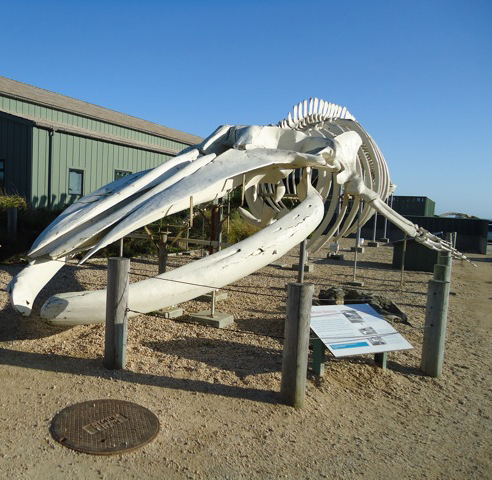
Mosses Grow on a New Substrate. Whale!

Mosses grow on all sorts of substrates. Soil, tree bark, leaves, rocks, sand, dung, old socks abandoned in the woods, and now a whale! My labmates were out visiting the Seymour Marine Discovery Center at Long Marine Laboratory in Santa Cruz, California over spring break and they brought back these photos of some Funaria hygrometrica (cord mosses) growing on a whale skeleton outside of the center. When they first told me that they found mosses growing on a whale I totally did not believe them, but I was imagining a breathing swimming whale. They even got permission from the Marine Center to collect some of the moss for us to use in our research collection. The description of this collection location on the label is going to be great! Thanks Laura and Juan Carlos for the photos.

You can read more about 'Ms. Blue' the whale here on the Marine Center's website. She has a pretty interesting story that goes from finding a blue whale washed up on the shore to her most recent relocation.


Happy April Fools Day!

More Sphagnum research

Directly after the article that I posted about earlier this week was another on Sphagnum by Dr. Eric Karlin and colleagues.

Eric F. Karlin, Sandra B. Boles, Rodney D. Seppelt, Stefano Terracciano, and A. Jonathan Shaw. 2011. The Peat Moss Sphagnum cuspidatum in Australia: Microsatellites Provide a Global Perspective. Systematic Botany 36(1):22-32.

I have yet to read the paper, but here is my non-technical summary of the abstract.

Want to now more about the controversy surrounding the species Sphagnum cuspidatum? Back in the day it was thought to grow on all continents except Antarctica. More recently scientists have proposed that it is limited to Europe and eastern North America. Herein the authors ask the question who is right? Does this species really grow all over the world or does it have a more restricted range? (Cue the dramatic music.) Plants from all over the world were gathered, DNA was removed from their cells and used in some cool science work with microsatelites. The researchers found that Sphagnum cuspidatum grows worldwide in places including Australia, the Philippines, Columbia, and Equatorial Guinea in addition to Europe and eastern North America. And the mystery has been illuminated! Though in science there is always room for more data, and thus reinterpretation of previous results. So this might not be the last word.

And the etymology helps the name stick to your brain

A brief bit about one of the journal articles from Systematic Botany that I read this week.

Câmara, Paulo E. A. S. 2011. A Re-Circumscription of the Moss Genus Taxithelium (Pylaisiadelphaceae) with a Taxonomic Revision of Subgenus Vernieri.  Systematic Botany 36: 7-21.

It is a taxonomic revision. Meaning that the author looked at all the species within a particular group, by requesting samples from across the world. Then examined them morphologically to determine what the species have in common and how the species are each different. There is typically a key to the species (think a choose your own adventure book that ends at an identification for the plant), illustrations and detailed descriptions. Here, 11 species in the Subgenus Vernieri are examined. The author undertook a large amount of work by examining 6,200 specimens. This type of work can only be described as tedious and time consuming. But I think that this work is essential to establishing good morphologically based species. I am looking forward to seeing the results of his molecular analyses to see if the species hold up. The paper said that they are unpublished, so keep an eye out for the phylogeny in a journal near you.

The fun fact that will help you remember this name of this genus (Taxithelium) is the defining feature of its members. They have multiple papillae on each cell that are arranged in a row. Papillae are little bumps on the outside of the cell that are raised portions of the cell wall. The etymology of the genus name is taxi- taso = arranged and thelion = nipple. Yes you heard it here arranged - nipple. Not a genus name to be easily forgotten. (I wonder if this will result in a whole different set of search hits for the blog? Surprise a page about mosses instead.)

This is another article that I read by this author last year that I really enjoyed.

Câmara, Paulo E. A. S. and Elizabeth A. Kellogg. 2010. Morphology and development of leaf papillae in Sematophyllaceae The Bryologist 113: 22-33.

Do you remember Encyclopedia?

I grew up in rural Indiana and we did not get the internet until my late middle school / early high school years. Before then there were these fabulous items called Encyclopedia. Perhaps many of you remember them? They were a large hardbound set of books where you could answer all your burning knowledge questions, before Google. We had a set when I was growing up and I remember spending hours looking up countries, topics or animals that I was interested in reading about. Often I would have questions and my Dad would send me to the encyclopedia to look things up. It was so much more fulfilling than the internet.

So what stimulated this post? Recently Dr. Eric Karlin sent me an email letting me know about another article featuring his Sphagnum study in the encyclopedia Britannica blog. I thought it would be nice to link to this post and I thus had encyclopedia on my mind. Happy reading!

The Bazzania Girls Band

Another great find from Juan Carlos!

It is a band names after the liverwort genus Bazzania. The Bazzania Girls Band plays a mix of Americana style music that encompasses country, gospel and traditional tunes. I really wanted to listen to some of their tunes and they have a podcast on their website but I couldn't find any audio files online.

If anyone has heard the band play it would be great to hear what you think about them in the comments section. Thanks!

Bryo Course

This is an announcement for a field course that came out on Bryonet a couple of weeks back. I just wanted to share it with anyone who might be interested. 

Intermediate Field Bryology  
March 21-23, 8:30 a.m.-5:00 p.m.
Klamath Hall, University of Oregon

Class size is limited. Fee: $300.To reserve a space, send $25 deposit (non-refundable processing fee). The balance is due ten days before the workshop. Invoices can be provided on request. Checks or money orders are preferable; make out to "Northwest Botanical Institute" and send to my PO Box. Credit cards can be processed only through PayPal (submit payment to davidwagner@mac.com).

Class will be held all day for three days, 8:30 a.m. - 5 p.m. 
Emphasis in this workshop is on using contemporary keys for identifying mosses, liverworts, and hornworts. Dissecting and compound microscopes will be on hand for observing the features necessary for using technical keys. Students with microscopes are urged to bring them. Methods of handling specimens and making preparations will be provided with ample practice material.

This is a very intensive workshop intended to give competence working with keys. All laboratory supplies needed for this class will be provided except specimen packets. Students should purchase the Keys to California mosses and liverworts prior to arrival. A list of recommended "Things to Bring" is below.

Travel, food and lodging for Introductory Field Bryology are the responsibility of the participants.  Participants should bring brown bag lunches each day; otherwise eateries are close by to the class site.

Additional information can be found below the fold.

TOOLS and SUPPLIES 
I'll provide slides and cover slips for use in the workshop. If you have good pair of fine pointed forceps, bring them along. If you want to get some ahead of time, a good source for these is BioQuip (I recommend their 4523 or 4524.):


 Otherwise, I can loan some for the workshop.

10X hand lens required (a good quality one is nice; I use a Bausch & Lomb with Hastings triplet lenses). We use this in lab and field. A 20X is also useful as a second lens; it takes much light and practice to use well and should be a back up to your 10X lens.

Dissecting microscope, optional but desirable. Compound microscope, optional but desirable. If you have your own instruments, please bring them as it is best to work with your regular equipment. I will help you calibrate them for optimal clarity. We will have good instruments available for use in the class.

50 paper specimen packets to start; more than 50 will be needed by the end of the workshop. These are for your personal reference set. You will use them to hold material I distribute in class and that which you will gather on the field trip. Ordinary copy or recycled/reusable paper is fine for this class; I will demonstrate how to make archival packets suitable for institutional herbarium use. 

Writing paper, pens and pencils 
Drawing paper or unlined paper notebooks for drawings 

BOOKS 
Primary textbook for mosses: "Contributions to a Bryoflora of California: II. A Key to the Mosses of California" by Norris and Shevock, Madroño vol. 51 No 2. If you don't have a copy, I have a few I'll provide at cost. 

For liverworts: "Contributions Toward a Bryoflora of California: III. Keys and annotated species catalog for liverworts and hornworts" by Doyle and Stotler. Madroño vol. 53 No 2. I have some copies of these, too, available at cost. 

Please try to get these before hand to study; the basic ordering protocol is: send check for $15 for each, $30 for both(payable to "California Botanical Society") to: 

California Botanical Society 
Jepson Herbarium 
1001 VSLB #2465 
University of California 
Berkeley, CA 94720-2465 
====================== 
The secondary text for liverworts is the "HTML Guide to Oregon Liverworts" by David Wagner. This is a work in progress; each participant will receive a personal copy on CD at the workshop. 
=======================
Other useful books: 
"CALIFORNIA MOSSES" by Bill and Nancy Malcolm, Jim Shevock, and Dan Norris
Reviewed in GYROTHYRA 6 (ask if you haven't gotten this). Superb adjunct to the Madroño keys.  $68 each, plus $6.50 shipping (only $1.00 each for shipping additional copies)  and CA sales tax for California residents.

To order, visit the CNPS store:
========================
"Some Common Mosses of British Columbia" by Wilf Schofield.  Best to get this directly from the Royal British Columbia Provincial Museum:  250-356-0505.  Have your credit card handy.  To get it through a book dealer in the U.S. will cost you MUCH more. (May be out of print.)

Flora of North America, volume 27, published 2007. Expensive but extremely valuable. If you can afford it, get from Oxford University Press. I have one copy to sell for a friend, new in box,at subscription cost ( about $85).
==================

PLACES TO STAY. The following motels are within walking distance of campus:
Best Western Greentree Inn. 1759 Franklin Blvd. 541-485-2727; 800-937-8376
Best Western New Oregon Motel. 1655 Franklin Blvd. 541-683-3669; 800-937-8376
Days Inn, 1859 Franklin Blvd.  541-342-6383; 800-444-6383
Holiday Inn. 2117 Franklin Blvd. 541-342-1243; 800-456-6487
Phoenix Inn. 850 Franklin Blvd. 541-344-0001; 800-344-0131
University Inn. 1847 Franklin Blvd. 541-342-4804; 800-424-5213
Travelers Inn. 540 E Broadway. 541-342-1109; 800-432-5213

For other possibilities and info about Eugene, here's the visitor center site:

===============
David H. Wagner, Ph.D.
Northwest Botanical Institute
P.O. Box 30064
Eugene, OR 97403-1064
U.S.A.

Moss Video

Another post recommended by Juan Carlos. (If he keeps coming up with fodder for the blog I might just have to make him a co-author on the blog and have him write the posts too. ) Thanks for sharing the link!

This is a video from the California Academy of Sciences in which Jim Shevock discusses mosses. He covers their reproduction, water requirements and dessication tolerance. There are also a number of great shots of mosses in the field. It is a nice video I think to introduce folks to mosses and to simulate some excitement about them.

Berry Go Round #36

The January edition of the plant carnival Berry Go Round has been posted at Seeds Aside.  The selection ranges this month from GMOs and a Fern rap to parasites and taxonomy. Enjoy the selection of posts!

For more about blog carnivals and my posts about the earlier editions of Berry Go Round, click here.