


A fellow graduate student forwarded along this link to a BBC news page reporting on the results of a photo competition. The photo that won the student category is a pair of moss sporophytes sticking out of the snow. (#13 in the series.) The photo is entitled Embrace. It is a great picture with nice imaginative imagery in the quote from the photographer. Some of the terms that she uses in the caption are not entirely bryologically accurate or maybe they are just not the terms that I would use. However I am trying to not be such a scientist, so I am not going to critique them here. I encourage you to suspend reality and any terminology hangups that you might have and to enjoy the beauty of these snowy sporophytes.
An additional news source that reported on the competition is the Guardian News. Click here for the link to another version of the moss image and its associated caption. (Photo #7)
(We are reading the book Don't Be Such a Scientist: Talking Substance in an Age of Style in the Science Communication seminar I am taking. Thus I am trying to relax into my science communication and not be so picky about terms especially when the above photo is art. We shall see how it works.)
Field of Science
-
-
Change of address1 year ago in Variety of Life
-
Change of address1 year ago in Catalogue of Organisms
-
-
Earth Day: Pogo and our responsibility1 year ago in Doc Madhattan
Moving and Mossing

A couple of weekends ago I helped one of my grad student pals move into his new house. I arrived a little early and explored the moss diversity on the property. There was an old well behind the house that was covered by mosses. It has a nice bit of species diversity. I have included some of the photos below.
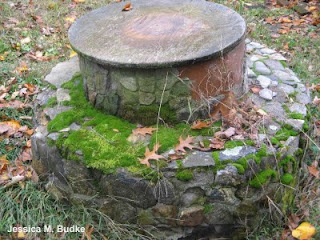


I was on a photo spree and did not do any collecting to identify the specific species. I think that I will have to visit again to do a more through survey.


Blogging Pause
October has been a busy month for me with a trip to Virginia and juggling a number of projects here in the lab. All the balls are still in the air and I am feeling pretty good about that. However as you can see the blogging has suffered, with my last post being over a month ago. I have been amassing ideas for new posts over the month and am planning to write some of those during the upcoming weekend.
For now...
- The latest edition of the plant blog carnival Berry Go Round is up at Beetles In The Bush (#21) for your perusal. My favorite article of the bunch was the post at The Natural Capital about wild grapes. It is a well written post with a good hook at the beginning. Then great facts on identifying wild grapes and tips on avoiding other fruiting plants that you might mistake for grapes.
- The trip to Virginia was to see a friend and former Grad Student from my department who now lives in Virginia. I left the shutter-bugging to the other gals so I don't have any pictures of our outing to the Shenandoah National Park. It was a great autumn day and there were tons of mosses to be seen! If you would like to see some photos and the tale of hiking adventures with four botanists you can check out Em's blog post here.
For now...
- The latest edition of the plant blog carnival Berry Go Round is up at Beetles In The Bush (#21) for your perusal. My favorite article of the bunch was the post at The Natural Capital about wild grapes. It is a well written post with a good hook at the beginning. Then great facts on identifying wild grapes and tips on avoiding other fruiting plants that you might mistake for grapes.
- The trip to Virginia was to see a friend and former Grad Student from my department who now lives in Virginia. I left the shutter-bugging to the other gals so I don't have any pictures of our outing to the Shenandoah National Park. It was a great autumn day and there were tons of mosses to be seen! If you would like to see some photos and the tale of hiking adventures with four botanists you can check out Em's blog post here.
Berry Go Round #20
The latest edition of the plant carnival Berry Go Round has been posted at Further Thoughts. Stop by to check out this month's plant posts from the blogosphere!
For more about blog carnivals and my posts about the earlier editions of Berry Go Round, click here.
For more about blog carnivals and my posts about the earlier editions of Berry Go Round, click here.
2009 Andrew's Foray Continued
One of the sites we visited on the foray was a Cat Den Swamp. There really weren't any areas of open water and the area was dominated by Sphagnum (peat moss). Thus I would have characterized it as a bog rather than a swamp. Bogs are really great habitats to visit. Boots are definitely a necessity or you could go for a pair of bare feet during the summer. I have been to some bogs that are like walking on a water-bed. This one was not that type. It was on full of slurpy sounds that almost pulled my boots off at times.


In addition to a lot of peat moss. They ranged in color from light green (above) to a burnt red (below). I didn't collect any Sphagnum mosses, nor did I try to identify them to species. I appreciate and enjoy peat moss much more on an larger ecological scale. They are cool to walk among but I'd rather not key them out to species under the microscope.


Above it can be seen that there are many shrubs in this area.

In addition to a lot of peat moss. They ranged in color from light green (above) to a burnt red (below). I didn't collect any Sphagnum mosses, nor did I try to identify them to species. I appreciate and enjoy peat moss much more on an larger ecological scale. They are cool to walk among but I'd rather not key them out to species under the microscope.

Mosses on The Colbert Report
I saw an episode of the Colbert Report last night and moss landscaping/gardening was featured in one of the jokes. You know that things are becoming more popular when they reach the late night comedy shows.
In part of the sketch he mentions turning a backyard koi pond into a peat bog. This statement is actually not impossible. Sphagnum sp. (peat moss) has the ability to change the acidity (pH) of the water in which it lives. It makes the water more acidic, which is better for the moss and usually worse for many of the other plants. Colbert did forget to mention that turning a koi pond into a bog will probably also kill all the koi.
If you are interested in cutting directly to the mossy reference it starts around 3:50min.
In part of the sketch he mentions turning a backyard koi pond into a peat bog. This statement is actually not impossible. Sphagnum sp. (peat moss) has the ability to change the acidity (pH) of the water in which it lives. It makes the water more acidic, which is better for the moss and usually worse for many of the other plants. Colbert did forget to mention that turning a koi pond into a bog will probably also kill all the koi.
If you are interested in cutting directly to the mossy reference it starts around 3:50min.
| The Colbert Report | Mon - Thurs 11:30pm / 10:30c | |||
| Atone Phone - Emmy Awards | ||||
| ||||
2009 Andrews Foray
I had a great time at the foray this past weekend! There were approximately 20 amateurs and professionals who came to study the lichens and mosses of northeastern Connecticut. I ran into an old friend who I hadn’t seen in years and I met some new folks who I hope to see in the future.
Over the course of the weekend we explored three different sites: Boston Hollow in the Yale Meyer’s Forest near Westford, Cat Den Swamp in the Natchaug State Forest near Eastford, and an area of the Windham Bog. (I didn’t make it to the last site due to a previous commitment, but that is where they said they were going.) The weekend weather was perfect! A little cool with the snap of the coming fall in the air and crisp blue skies overhead.
The first site was identified by the lichenologists as a talus slope with a wet seepy area near the road. I had to ask for the definition of talus and was told that it is a fancy word for a pile of rocks at the base of a cliff or slope. They were pretty big rocks and I probably would have called them boulders, but tallus works well too. Being out in the field with bryologists who can identify more plants than I can was a little intimidating, but it also resulted in my learning to recognize a number of new species in the field.
I spent most of my time acting as a sponge absorbing information and only took a few photos. Unfortunately when I went back to pick some to put up with this post I was disappointed to find some really fuzzy photos and only a couple that are even close to in focus. Despite that I will post a few up here for a splash of green and give you some description of them below.


Above center is some Mniaceae. (the 'M' is silent in the pronunciation) The leaves are whirled into a splash cup that is filled with male sex organs (antheridia). To the above-right is a very small moss whose spore filled capsules are not elevated on a stalk. Thus they appear to be sitting directly on the soil. This is a member of the genus Diphyscium. The above-left is a common genus that I often see in Connecticut forests, but a new species for me. It is Thuidium minutulum. I love the name. It means the miniature Thuidium and that is just what it looks like. A very small slender version of the robust Thuidium that I often see covering rocks or soil in Connecticut.
A special thanks goes out to Juan Sanchez who organized the trip and lodging.
I will have another story about the foray later this week or next. Stay tuned for more mosses...
Moss Poetry
I have recently corresponded with Ruth Hill the author of the poem "The Tundra Terrarium" that I posted about back on April 30th of this year. We had a really great exchange and she had this to share about the poem,
"The subtitle, "May Day," of course refers to Spring; but the second "May Day" is a distress call from the environment. The unusual format, with the words thrown off to the side, is supposed to be reminiscent of the surprising way some Bryophytes "throw" their spores far and wide for reproduction, as if they are "Spring-loaded!" (Pun intended.) The words of the poem are "thrown off" like spores. I like to invite people to get off their duff and get out into the duff, so to speak." - Ruth Hill; ruthhill@joiedevivregardens.caI think that insights into a poem or other literature directly from the author is great! It can really alter how you see and feel the written word. If you know of anyone who is writing bryo-poetry feel free to pass their name along. I would be happy to help share their work with a wider audience via this blog.
Mosses Featured at United States National Parks
I did a search recently because I was interested to see how many of our National Parks discuss or feature the mosses that live in the parks. Here are a few of the interesting pages that I found and my comments on them. (They are not arranged in any particular order.)
Mt Ranier National Park - Washington
In 1939 Dr. E. T. Bodenberg wrote a moss flora about this park. It has a really thorough introduction that covers everything from the moss life cycle to how particular features of the park affect the mosses growing there. A checklist of the mosses in the park and a key to their identification is also included. Also interesting to note is that samples of all of the species included in this flora have been collected and placed in the park's herbarium. A herbarium is a collection of dried plant samples associated with location information that acts as a natural history record of the plants from a particular area.
Denali National Park and Preserve - Alaska
This park has a very animated and detailed section about the mosses. They also include an informative list of reasons for bryophytes being so broadly distributed across the globe.
Arches National Park - Utah
This park has a really great page discussing desert mosses and their ability to survive long dry periods (aka. desiccation).
Cape Krusenstern National Monuemant - Alaska
Sphagnum sp. (peat moss) is mentioned as a major player in the tundra habitat that is dominant at this location.
Canyonlands National Park - Utah
This site pretty much reuses the same information and photo as those at Arches National Park. I think that it is all still applicable since the habitat in the two locations is probably very similar. However more bryophyte details specific to the park would have been appreciated.
Grand Teton National Park - Wyoming
This park has a really great page that highlights the mosses and liverworts and the role that they play in this park.
Shenandoah National Park - Virginia
This park quotes the number of bryophytes that they have growing at the park = 208 species of moss and 58 species of liverwort. They also list some references and website links for more bryophyte information. The websites look to have good information and are associated with major universities. I think that their liverwort book selection is good, while their moss recommendation is a 2 volume set that costs ~$300. I would recommend a library if you are interested in checking out this thorough work on mosses.
(Pet Peeve: Below the photo it describes the mosses as 'fruiting'. That term is commonly used but biologically incorrect. Bryophytes do not form flowers, seeds or fruits! But fruiting is an easier term to use than sporing, which is not a technical or even real term. It could just be said that they are reproducing.)
ParkWise - Educational Resources for Alaskan National Parks
Mosses are included as part of this exercise about successional plants.
Redwood National & State Parks - California
Bandelier National Monument - New Mexico
Both of these parks mention moss being used by birds as nesting material.
National Battlefield Park - Virginia
This park has a page with a nice photo that features the mosses and liverworts.
I hope that you enjoy these webpages about mosses and liverworts living at our National parks, preserves, and monuments. If you have any stories about the bryophytes at your local parks feel free to share them in the comments section.
Mt Ranier National Park - Washington
In 1939 Dr. E. T. Bodenberg wrote a moss flora about this park. It has a really thorough introduction that covers everything from the moss life cycle to how particular features of the park affect the mosses growing there. A checklist of the mosses in the park and a key to their identification is also included. Also interesting to note is that samples of all of the species included in this flora have been collected and placed in the park's herbarium. A herbarium is a collection of dried plant samples associated with location information that acts as a natural history record of the plants from a particular area.
Denali National Park and Preserve - Alaska
This park has a very animated and detailed section about the mosses. They also include an informative list of reasons for bryophytes being so broadly distributed across the globe.
Arches National Park - Utah
This park has a really great page discussing desert mosses and their ability to survive long dry periods (aka. desiccation).
Cape Krusenstern National Monuemant - Alaska
Sphagnum sp. (peat moss) is mentioned as a major player in the tundra habitat that is dominant at this location.
Canyonlands National Park - Utah
This site pretty much reuses the same information and photo as those at Arches National Park. I think that it is all still applicable since the habitat in the two locations is probably very similar. However more bryophyte details specific to the park would have been appreciated.
Grand Teton National Park - Wyoming
This park has a really great page that highlights the mosses and liverworts and the role that they play in this park.
Shenandoah National Park - Virginia
This park quotes the number of bryophytes that they have growing at the park = 208 species of moss and 58 species of liverwort. They also list some references and website links for more bryophyte information. The websites look to have good information and are associated with major universities. I think that their liverwort book selection is good, while their moss recommendation is a 2 volume set that costs ~$300. I would recommend a library if you are interested in checking out this thorough work on mosses.
(Pet Peeve: Below the photo it describes the mosses as 'fruiting'. That term is commonly used but biologically incorrect. Bryophytes do not form flowers, seeds or fruits! But fruiting is an easier term to use than sporing, which is not a technical or even real term. It could just be said that they are reproducing.)
ParkWise - Educational Resources for Alaskan National Parks
Mosses are included as part of this exercise about successional plants.
Redwood National & State Parks - California
Bandelier National Monument - New Mexico
Both of these parks mention moss being used by birds as nesting material.
National Battlefield Park - Virginia
This park has a page with a nice photo that features the mosses and liverworts.
I hope that you enjoy these webpages about mosses and liverworts living at our National parks, preserves, and monuments. If you have any stories about the bryophytes at your local parks feel free to share them in the comments section.
New Bryophyte Guide
I think that there is really a void when it comes to bryophyte field guides for amateurs. I have sent emails to both the Peterson's Field Guide company and the Finder guides suggesting that a guide to the moss genera of North America is desperately needed. Unfortunately there was no reply from either company. I guess they don't think that there is a market for this type of guide. I think that there is, considering that I am asked about what field guide I would recommend quite often.
The first guide that I purchased was Conrad and Redfearn's "How to know the mosses and liverworts". This guide is ok, but the dichotomous key at the beginning is really long and painful. You have to really want to learn about mosses to pull the information that you desire out of this book. Also some of the characteristics they have you look for are microscopic and really cannot be seen with a 10X handlens.
An announcement came out on Bryonet a while back about a new bryophyte guide. It is entitled "A Trailside Guide to Mosses and Liverworts of the Cherokee National Forest" by Paul G. Davison with contributions from Mark J. Pistrang. If you have never visited the Cherokee National Forest, it is a fabulous place. I carried out some of my undergraduate research there and participated in the All Taxa Biodiversity Inventory in the Smoky Mountains. Fortunately many of the genera in this area overlap with other eastern deciduous forest regions of the United States, and thus could be used outside of the region.
I have purchased a copy and I think that this book is great. There are multiple color photographs per genus. The text includes a description about the genus; notes on habitat, size, distinguishing characteristics and reproduction; the number of species in the genus that live in the Southern Appalachian Mountains; the distribution of the genus within Eastern North America. The book covers 52 genera and focuses on larger scale photographs. Thus a microscope is not needed, which is critical for making field identifications.
The specific species that are covered may not be found in your area, but I think that identifications of mosses and liverworts to genus are just fine. When I lead moss walks and teach people local plants we only talk about them in terms of the genus identification. Really to identify these plants to species you need a microscope. However there are a lot of genera to be learned with ~12,000 different moss species worldwide.
The first guide that I purchased was Conrad and Redfearn's "How to know the mosses and liverworts". This guide is ok, but the dichotomous key at the beginning is really long and painful. You have to really want to learn about mosses to pull the information that you desire out of this book. Also some of the characteristics they have you look for are microscopic and really cannot be seen with a 10X handlens.
An announcement came out on Bryonet a while back about a new bryophyte guide. It is entitled "A Trailside Guide to Mosses and Liverworts of the Cherokee National Forest" by Paul G. Davison with contributions from Mark J. Pistrang. If you have never visited the Cherokee National Forest, it is a fabulous place. I carried out some of my undergraduate research there and participated in the All Taxa Biodiversity Inventory in the Smoky Mountains. Fortunately many of the genera in this area overlap with other eastern deciduous forest regions of the United States, and thus could be used outside of the region.
I have purchased a copy and I think that this book is great. There are multiple color photographs per genus. The text includes a description about the genus; notes on habitat, size, distinguishing characteristics and reproduction; the number of species in the genus that live in the Southern Appalachian Mountains; the distribution of the genus within Eastern North America. The book covers 52 genera and focuses on larger scale photographs. Thus a microscope is not needed, which is critical for making field identifications.
The specific species that are covered may not be found in your area, but I think that identifications of mosses and liverworts to genus are just fine. When I lead moss walks and teach people local plants we only talk about them in terms of the genus identification. Really to identify these plants to species you need a microscope. However there are a lot of genera to be learned with ~12,000 different moss species worldwide.
Salt-Shaker Spore Dispersal
Mosses in the Polytrichaceae spread their spores in a really neat way. Shown here are Atrichum sporophytes. Another member of the family that I have blogged about is Polytrichum, which also shares this dispersal mechanism.
 Atrichum's manner of spores dispersal has been described as a salt shaker mechanism. And as you can see on the up-close shot below, it is a pretty good analogy. The mouth of the capsule is surrounded by a ring of short, immovable teeth that attach to a disc covering the opening to the capsule. The disc keeps rain from entering the capsule so that the spores do not start to grow before they have exited the capsule. When a breeze or a passing animal jostles the capsule the spores sift out from between the teeth. This mechanism also keeps the spores from coming out in a single mass, which would pretty much defeat the ability of these spores to spread on the wind.

If you are ever out in the woods and see some Artichum (or Polytrichum) sporophytes, give them a tap. You may be rewarded by a poof of spores emanating from the top of the capsule.
Fun Fact: Spores are so small and light that they can disperse very long distances. Researchers carried out a study (I am not sure of the reference off the top of my head, but I will check.) where they attached sticky microscope slides to the wings of a plane that flew high into the air. What do you know, they found moss spores all the way up in the the jet-stream. Pretty cool that they are able to travel that far up and then far away!
 Atrichum's manner of spores dispersal has been described as a salt shaker mechanism. And as you can see on the up-close shot below, it is a pretty good analogy. The mouth of the capsule is surrounded by a ring of short, immovable teeth that attach to a disc covering the opening to the capsule. The disc keeps rain from entering the capsule so that the spores do not start to grow before they have exited the capsule. When a breeze or a passing animal jostles the capsule the spores sift out from between the teeth. This mechanism also keeps the spores from coming out in a single mass, which would pretty much defeat the ability of these spores to spread on the wind.
If you are ever out in the woods and see some Artichum (or Polytrichum) sporophytes, give them a tap. You may be rewarded by a poof of spores emanating from the top of the capsule.
Fun Fact: Spores are so small and light that they can disperse very long distances. Researchers carried out a study (I am not sure of the reference off the top of my head, but I will check.) where they attached sticky microscope slides to the wings of a plane that flew high into the air. What do you know, they found moss spores all the way up in the the jet-stream. Pretty cool that they are able to travel that far up and then far away!
Growing Mosses
I have received a number of emails over the past couple of months with questions about gardening with mosses outdoors. Most of my personal moss growing experience focuses on the plants that I grow in the laboratory. I have little terrariums (culture containers) from Fisher Scientific that work great in the lab.
As for moss gardening outside here are a few resources to get you started.
- The British Bryological Society has a publication entitled "The Moss Grower's Handbook", that you can link to here. This book discusses both liverworts and mosses. It is a really nice read and goes into detail about specific growing conditions for particular species.
- Researchers at Glacier National Park have published an article about moss propagation for re-vegetation projects in the park. A link for the article and a pdf version can be found here. They illustrate a nice setup for growing mosses indoors to be planted outside after they are established.
- Schenk, G. 1997. Moss Gardening: including lichens, liverworts and other miniatures. Timber Press: Portland, Oregon.
A good reference book for landscaping/gardening with mosses that is filled with nice color photos. It also covers growing specifics for particular species. My only critique of the book is that it could use a little more focus on issues of conservation.
- Cullina, William. 2008. Native Ferns, Moss, and Grasses: From Emerald Carpet to Amber Wave, Serene and Sensuous Plants for the Garden. Houghton Mifflin Harcourt.
This book has been on my wish-list for a while, but I have yet to purchase/read it. So I am not sure how helpful it is, but it does have an entire section on gardening with mosses. If anyone has read this book and has an opinion on its utility for moss gardening, feel free to let me know.
Thanks for all the moss gardening questions and I hope that my answers were helpful. If you have any other suggestions for good moss gardening resources please drop a note in the comments section.
As for moss gardening outside here are a few resources to get you started.
- The British Bryological Society has a publication entitled "The Moss Grower's Handbook", that you can link to here. This book discusses both liverworts and mosses. It is a really nice read and goes into detail about specific growing conditions for particular species.
- Researchers at Glacier National Park have published an article about moss propagation for re-vegetation projects in the park. A link for the article and a pdf version can be found here. They illustrate a nice setup for growing mosses indoors to be planted outside after they are established.
- Schenk, G. 1997. Moss Gardening: including lichens, liverworts and other miniatures. Timber Press: Portland, Oregon.
A good reference book for landscaping/gardening with mosses that is filled with nice color photos. It also covers growing specifics for particular species. My only critique of the book is that it could use a little more focus on issues of conservation.
- Cullina, William. 2008. Native Ferns, Moss, and Grasses: From Emerald Carpet to Amber Wave, Serene and Sensuous Plants for the Garden. Houghton Mifflin Harcourt.
This book has been on my wish-list for a while, but I have yet to purchase/read it. So I am not sure how helpful it is, but it does have an entire section on gardening with mosses. If anyone has read this book and has an opinion on its utility for moss gardening, feel free to let me know.
Thanks for all the moss gardening questions and I hope that my answers were helpful. If you have any other suggestions for good moss gardening resources please drop a note in the comments section.
Subscribe to:
Posts (Atom)