


The tenth edition of Berry Go Round has been posted at 10,000 Birds. Berry Go Round is a monthly blog carnival all about plants. Enjoy!
For more about blog carnivals and my posts about the earlier editions of Berry Go Round, click here.
Field of Science
-
-
Change of address1 year ago in Variety of Life
-
Change of address1 year ago in Catalogue of Organisms
-
-
Earth Day: Pogo and our responsibility1 year ago in Doc Madhattan
Mosses in a Magazine

An article came out this month in the New Life Journal about gardening with mosses. This article was written by of Mountain Moss in North Carolina.
The article has some good moss biology tucked among the gardening tips. She discusses the fact that mosses do not have roots and instead have rhizoids to attach them to the soil. Also she touches on the fact that mosses do not have xylem cells to move water inside their plant body.
Another interesting tidbit that she shares is that mosses can even be seen in the 5000 year old gardens in Kyoto, Japan. I linked to the article that she cited, because I was interested to see if they were talking about the moss temple (Saiho-ji). I visited this temple while I was in Japan this past summer and I was excited to hear what they had to say about it. (Click here for a link to my post about the Saiho-ji temple in Kyoto.)

I was surprised to discover that the Smithsonian Magazine article that she cited did not mention the Saiho-ji temple. Instead it focused on the Ryoan-ji temple (the temple of the peaceful dragon). The focal point of this temple is a zen rock garden that has a number of rocks and mosses surrounded by raked stones.
This is one of the temples in Kyoto that I visited in addition to the Saiho-ji temple. There were not nearly as many mosses as the moss temple, but being that it was a zen aesthetic, less is more. The zen rock garden was very peaceful looking place and my photos capture its true essence.
However being there was quite a different exprience. All the visitiors to the garden sit on a large wooden porch overlooking the area shown here in the photos. You might think that everyone would be sitting quietly meditating as they stare at the stones. If that is what you imagined then you would be wrong. It is more like 40 foreigners sitting on the porch chatting loudly, some of them talking on their cell phones, while the zen stones stare back in dismay.
I was really surprised that they didn't have some sort of talking rules to encourage a meditative atmosphere. Oh well, I will just have to enjoy the meditative experience from my silent photos. It's a little sad that they are better than the actual experience, but I am glad to have gone and given it a try.

The article has some good moss biology tucked among the gardening tips. She discusses the fact that mosses do not have roots and instead have rhizoids to attach them to the soil. Also she touches on the fact that mosses do not have xylem cells to move water inside their plant body.
Another interesting tidbit that she shares is that mosses can even be seen in the 5000 year old gardens in Kyoto, Japan. I linked to the article that she cited, because I was interested to see if they were talking about the moss temple (Saiho-ji). I visited this temple while I was in Japan this past summer and I was excited to hear what they had to say about it. (Click here for a link to my post about the Saiho-ji temple in Kyoto.)

I was surprised to discover that the Smithsonian Magazine article that she cited did not mention the Saiho-ji temple. Instead it focused on the Ryoan-ji temple (the temple of the peaceful dragon). The focal point of this temple is a zen rock garden that has a number of rocks and mosses surrounded by raked stones.
This is one of the temples in Kyoto that I visited in addition to the Saiho-ji temple. There were not nearly as many mosses as the moss temple, but being that it was a zen aesthetic, less is more. The zen rock garden was very peaceful looking place and my photos capture its true essence.
However being there was quite a different exprience. All the visitiors to the garden sit on a large wooden porch overlooking the area shown here in the photos. You might think that everyone would be sitting quietly meditating as they stare at the stones. If that is what you imagined then you would be wrong. It is more like 40 foreigners sitting on the porch chatting loudly, some of them talking on their cell phones, while the zen stones stare back in dismay.
I was really surprised that they didn't have some sort of talking rules to encourage a meditative atmosphere. Oh well, I will just have to enjoy the meditative experience from my silent photos. It's a little sad that they are better than the actual experience, but I am glad to have gone and given it a try.

Some More Mosses from Japan
While in Japan I traveled to the small town of Nozawa Onsen. It is about an hour north of Nagano, via train and then bus. Nozawa is nestled in the mountains and is famous for the many onsen (hot springs) that dot the village. I hear that it is also a great place to ski and we saw many ski lifts heading up into the surrounding mountains. While walking around town we visited a shrine that was surrounded by moss.

However, I did not collect any mosses. I am not sure what the karma impact might be from collecting moss from the grounds of a shrine. So I just took some pictures instead.
The photo to the right is a member of the Orthotricaceae. All of the little tan/brown structures are the sporophytes. The Orthotricaceae are recognized by their short sporophytes with upright capsules. Typically they grow on tree bark or rocks and have dark green gametophytes that can sometimes appear black when dry.

Sculptures on the grounds of the shrine were covered in mosses!


These a a couple of shots of some Fissidens sp. Members of this genus have a really gorgeous morphology! The leaves do not spiral around the stem as in most mosses. In Fissidens they have a distichous leaf arrangement, meaning that they are positioned 180 degrees opposite each other on the stem. It is the same leaf arrangement that you see in Iris plants. This distintictive pattern of leaves makes mosses in the genus Fissidens stand out from other species in the field.

However, I did not collect any mosses. I am not sure what the karma impact might be from collecting moss from the grounds of a shrine. So I just took some pictures instead.
The photo to the right is a member of the Orthotricaceae. All of the little tan/brown structures are the sporophytes. The Orthotricaceae are recognized by their short sporophytes with upright capsules. Typically they grow on tree bark or rocks and have dark green gametophytes that can sometimes appear black when dry.

Sculptures on the grounds of the shrine were covered in mosses!


These a a couple of shots of some Fissidens sp. Members of this genus have a really gorgeous morphology! The leaves do not spiral around the stem as in most mosses. In Fissidens they have a distichous leaf arrangement, meaning that they are positioned 180 degrees opposite each other on the stem. It is the same leaf arrangement that you see in Iris plants. This distintictive pattern of leaves makes mosses in the genus Fissidens stand out from other species in the field.
Examining Moss Filaments: Protonema & Rhizoids
Every week members of the Goffinet Laboratory group meet to discuss a research journal article about bryophytes. The papers that we read range from morphological to molecular and may relate to either mosses, hornworts, or liverworts, all of which we study in the laboratory. Last week's paper focused on moss protonema and rhizoids.

Protonema are unicellular filaments of haploid/gametophyte tissue. In the moss life cycle a spore germinates to produce filamentous protonema that then develop into leafy gametophytes. At right is a photograph of the protonema of Funaria hygrometrica.
 Pressel, S., Ligrone, R. and J. G. Duckett. 2008. Cellular Differentiation in Moss Protonemata: A Morphological and Experimental Study. Annals of Botany 102:227-245.
This research paper focuses on three types of bryophyte filaments: chloronema and caulonema (both types of protonema) and rhizoids. They define rhizoids as filaments that are produced only by the mature leafy gametophyte plants. They are often pigmented brown and function to attach the gametophyte to the substrate (soil, tree bark, or rock that they are growing on).
They had a number of goals for their research, but I am not going to go into all of them. The one that I found the most interesting was that they examined 200 moss species and determined the cellular changes that occur during differentiation of the caulonema and rhizoid filaments. (Differentiation is the process by which cells acquire all of the characteristics that they will have at maturity.) You may ask why just describe a maturation process inside of the cells. Well as the authors mention (and I wholeheartedly agree), it is important to describe the sequence of events that occur in these filaments because it lays the foundation for future experiments. Researchers have to know how structures develop normally, so that they have a control/baseline to compare to experiments.
Additionally, the paper is full of great images. There are light microscopy photos zoomed in to the point that you can see the nucleus inside of the cell. Some of the other images illustrate a feature that I had not heard of before. The rhizoids produce a mucilage sheath (i.e. slime) that covers the entire outside of the cell wall. The remainder of the images are transmission electron micrographs that show all sorts of cellular structures. You can see mitochondria, chloroplasts, golgi bodies and nuclei, just to name a few. In order to see these structures some serious magnification is needed. These organelles are probably magnified 10,000-50,000X. I think that it is just really fabulous that we can see all of these tiny biological features inside of the cells!

Protonema are unicellular filaments of haploid/gametophyte tissue. In the moss life cycle a spore germinates to produce filamentous protonema that then develop into leafy gametophytes. At right is a photograph of the protonema of Funaria hygrometrica.
Pressel, S., Ligrone, R. and J. G. Duckett. 2008. Cellular Differentiation in Moss Protonemata: A Morphological and Experimental Study. Annals of Botany 102:227-245.This research paper focuses on three types of bryophyte filaments: chloronema and caulonema (both types of protonema) and rhizoids. They define rhizoids as filaments that are produced only by the mature leafy gametophyte plants. They are often pigmented brown and function to attach the gametophyte to the substrate (soil, tree bark, or rock that they are growing on).
They had a number of goals for their research, but I am not going to go into all of them. The one that I found the most interesting was that they examined 200 moss species and determined the cellular changes that occur during differentiation of the caulonema and rhizoid filaments. (Differentiation is the process by which cells acquire all of the characteristics that they will have at maturity.) You may ask why just describe a maturation process inside of the cells. Well as the authors mention (and I wholeheartedly agree), it is important to describe the sequence of events that occur in these filaments because it lays the foundation for future experiments. Researchers have to know how structures develop normally, so that they have a control/baseline to compare to experiments.
Additionally, the paper is full of great images. There are light microscopy photos zoomed in to the point that you can see the nucleus inside of the cell. Some of the other images illustrate a feature that I had not heard of before. The rhizoids produce a mucilage sheath (i.e. slime) that covers the entire outside of the cell wall. The remainder of the images are transmission electron micrographs that show all sorts of cellular structures. You can see mitochondria, chloroplasts, golgi bodies and nuclei, just to name a few. In order to see these structures some serious magnification is needed. These organelles are probably magnified 10,000-50,000X. I think that it is just really fabulous that we can see all of these tiny biological features inside of the cells!
Berry Go Round #9
The ninth edition of Berry Go Round has been posted at Gravity's Rainbow. Berry Go Round is a monthly blog carnival all about plants. Enjoy!
For more about blog carnivals and my posts about the earlier editions of Berry Go Round, click here.
Mossy Frog at the New England Aquarium
I visited Boston a couple of weeks ago and we stopped in for an afternoon at the New England Aquarium. It was my first visit and I enjoyed it immensely. My favorites included the 70 year old green sea turtle who doesn't like to eat broccoli, but she does like lettuce and brussel sprouts. They also have a great exhibit about jellyfish. The jellyfish were very beautifully dangerous floating around in their tanks. The exhibit also included a lot of educational information regarding jellyfish populations and global climate change. With the warming of the oceans we are in for some serious jellyfish overpopulation issues and since these animals are predators they are going to eat quite a lot of the other sea creatures. Good for the jellyfish. Bad for everything else.
In a surprising turn of events I ran into some moss at the aquarium! Mainly it was used in the exhibits of the tropical species to soften the surroundings, keep things moist, and add some greenery. The photo below was the mossiest one of them all!

And what animal just happens to live in the display full of moss? Oh, the mossy frog Theloderma corticale. Many organisms have common names that describe the other plants or animals that they look like. There are the fern mosses (Thuidium sp.) and the feather mosses (Hypnum sp.), just to name a few.
I would have to agree that this frog is well camoflauged to sit on mossy tree trunks and hide from predators. It is an example of an organism evolving to blend in with its surroundings. Those frogs who did not blend in would have been eaten by predators and those that blended in would have been survived to reproduce more mossy looking frogs. This system of natural selection over many years has led to the highly patterned and frilly frog that we see today. (Check out the bottom photo to get a sense of how frilly the arms and legs of the frog were. That was my favorite part about him/her!)

Here is a close up shot of the little guy/gal. I had a hard time shooting through the glass front of the exhibit , so I apologize for the fuziness. You can see some additional photos on the wiki page of this frog species.
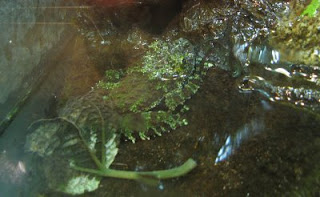
In a surprising turn of events I ran into some moss at the aquarium! Mainly it was used in the exhibits of the tropical species to soften the surroundings, keep things moist, and add some greenery. The photo below was the mossiest one of them all!

And what animal just happens to live in the display full of moss? Oh, the mossy frog Theloderma corticale. Many organisms have common names that describe the other plants or animals that they look like. There are the fern mosses (Thuidium sp.) and the feather mosses (Hypnum sp.), just to name a few.
I would have to agree that this frog is well camoflauged to sit on mossy tree trunks and hide from predators. It is an example of an organism evolving to blend in with its surroundings. Those frogs who did not blend in would have been eaten by predators and those that blended in would have been survived to reproduce more mossy looking frogs. This system of natural selection over many years has led to the highly patterned and frilly frog that we see today. (Check out the bottom photo to get a sense of how frilly the arms and legs of the frog were. That was my favorite part about him/her!)

Here is a close up shot of the little guy/gal. I had a hard time shooting through the glass front of the exhibit , so I apologize for the fuziness. You can see some additional photos on the wiki page of this frog species.

Practicing your Spanish and Reading about Bryophytes
Juan Carlos, one of my labmates, sent out a link to this bryology blog written in Spanish. It has been online since January 2008, but I was unaware of it. I read some Spanish, but a majority of the bryology literature that I read is in English.
The aim of the blog is to share news of interest about bryology, bryologists and their research with the international community. Anyone who wishes can contribute to this blog. There are instructions for adding a post on the website.
There are several nice features in the sidebar on the right that. There is a list of bryology articles that have been published recently in scientific journals. There are also links to some of the top bryology journals in the field, so that you can browse through to see the tables of contents. You may not be able to access the full articles from home, but if you are at a university then you would probably have access. Finally there are a number of links to information pages about Latin American bryophytes. I think that it is a very nice website, but the posting is a little infrequent. So if you have anything to say about bryophytes, in Spanish, or about Latin American bryophytes, this would be the place to share it.
The aim of the blog is to share news of interest about bryology, bryologists and their research with the international community. Anyone who wishes can contribute to this blog. There are instructions for adding a post on the website.
There are several nice features in the sidebar on the right that. There is a list of bryology articles that have been published recently in scientific journals. There are also links to some of the top bryology journals in the field, so that you can browse through to see the tables of contents. You may not be able to access the full articles from home, but if you are at a university then you would probably have access. Finally there are a number of links to information pages about Latin American bryophytes. I think that it is a very nice website, but the posting is a little infrequent. So if you have anything to say about bryophytes, in Spanish, or about Latin American bryophytes, this would be the place to share it.
New Addition to the Goffinet Lab Website
One of my advisors, Dr. Bernard Goffinet, maintains a website for our bryophyte lab group. Recently two classification outlines were added to the website (under the heading Links), one each for mosses and hornworts. For the mosses there is an alphabetical list of all the current genera at the top of the page. By clicking on a genus name you are whisked away to the location of that genus in the overall classification.
If is has been a while since you thought about classification systems for organisms you might need to bust out your favorite old pneumonic device. The one I learned was Kings Play Cards On Fat Green Stools, which usually helps me to remember Kingdom Phylum Class Order Family Genus Species. However the latest classification schemes have added another layer above Kingdom, which is Domain. There are three of these and plants fall into the Domain Eukarya. I won't bore you with the history of how we arrived at this three domain system, but if you are interested the wiki page for biological classification has some good info. So for mosses the upper end of the classification goes something like this...
Domain Eukarya
Kingdom Plantae
Phylum Bryophyta
The online classification starts with Subdivisions, a half step below Phylum, and then continues on from there. Besides Subdivision, there are a couple other classification ranks that may be unfamiliar, but they are pretty intuitive. From this list you can see other closely related genera, closely related families, and so on.
The hornwort classification is maintained by one of my labmates, Juan Carlos Villarreal and it comes with detailed descriptions of the individual genera.
Overall I think that it is a great contribution to have this information out on the web. The classification systems will also be coming out in print in the second edition of Bryophyte Biology, from Cambridge University Press. This book will be available to the public in November. Until then, enjoy this advance version of the classifications.
If is has been a while since you thought about classification systems for organisms you might need to bust out your favorite old pneumonic device. The one I learned was Kings Play Cards On Fat Green Stools, which usually helps me to remember Kingdom Phylum Class Order Family Genus Species. However the latest classification schemes have added another layer above Kingdom, which is Domain. There are three of these and plants fall into the Domain Eukarya. I won't bore you with the history of how we arrived at this three domain system, but if you are interested the wiki page for biological classification has some good info. So for mosses the upper end of the classification goes something like this...
Domain Eukarya
Kingdom Plantae
Phylum Bryophyta
The online classification starts with Subdivisions, a half step below Phylum, and then continues on from there. Besides Subdivision, there are a couple other classification ranks that may be unfamiliar, but they are pretty intuitive. From this list you can see other closely related genera, closely related families, and so on.
The hornwort classification is maintained by one of my labmates, Juan Carlos Villarreal and it comes with detailed descriptions of the individual genera.
Overall I think that it is a great contribution to have this information out on the web. The classification systems will also be coming out in print in the second edition of Bryophyte Biology, from Cambridge University Press. This book will be available to the public in November. Until then, enjoy this advance version of the classifications.
Saiho-ji Temple: The Moss Temple

The mosses were a little crispy, seeing as how I visited during the dry hot part of the summer. I think that this temple would be even better to visit during the rainy season in the spring and earlier summer. I am not quite sure that I saw 120 species of mosses, but they covered all the available surfaces on the grounds.


A tree base surrounded by Leucobryum sp.


A New Bryophyte Website
I recently heard about a new bryophyte website brought to you by the Friends of the Australian National Botanic Garden. The website includes some general information on bryophytes, such as life cycles, ecology and classification. A good bit of the information is Australia specific. I especially enjoyed the information on Australian Bryogeography and Endemic Species. There is also a whole section detailing the history of bryology in Australia.
The website is really well done and it provides a wealth of information. In particular, check out the link to the case studies. There are approximately 30 entries that boil down scientific research articles into easily digestible summaries with helpful figures.
There is also a list of identification guides for Australian bryophytes. Basically, if you are interested in bryophytes in Australia this is the website for you.
The website is really well done and it provides a wealth of information. In particular, check out the link to the case studies. There are approximately 30 entries that boil down scientific research articles into easily digestible summaries with helpful figures.
There is also a list of identification guides for Australian bryophytes. Basically, if you are interested in bryophytes in Australia this is the website for you.
Berry Go Round #8
The eighth edition of Berry Go Round has been posted at Not Exactly Rocket Science. This is a monthly blog carnival all about plants. Enjoy!
For more about blog carnivals and my posts about the earlier editions of Berry Go Round, click here.
For more about blog carnivals and my posts about the earlier editions of Berry Go Round, click here.
Back Home
Whew! The last few weeks in Japan were quite the whirlwind. I have arrived in Connecticut and am settling back into life and research. All the business has kept me away from the blog, but I am hoping to be back to regular postings starting this week.
I also wanted to announce that I will be leading a Moss Walk at the Denison Pequotsepos Nature Center in Mystic, CT at the end of September. Click here for more details about the workshop.
I also wanted to announce that I will be leading a Moss Walk at the Denison Pequotsepos Nature Center in Mystic, CT at the end of September. Click here for more details about the workshop.
Subscribe to:
Posts (Atom)